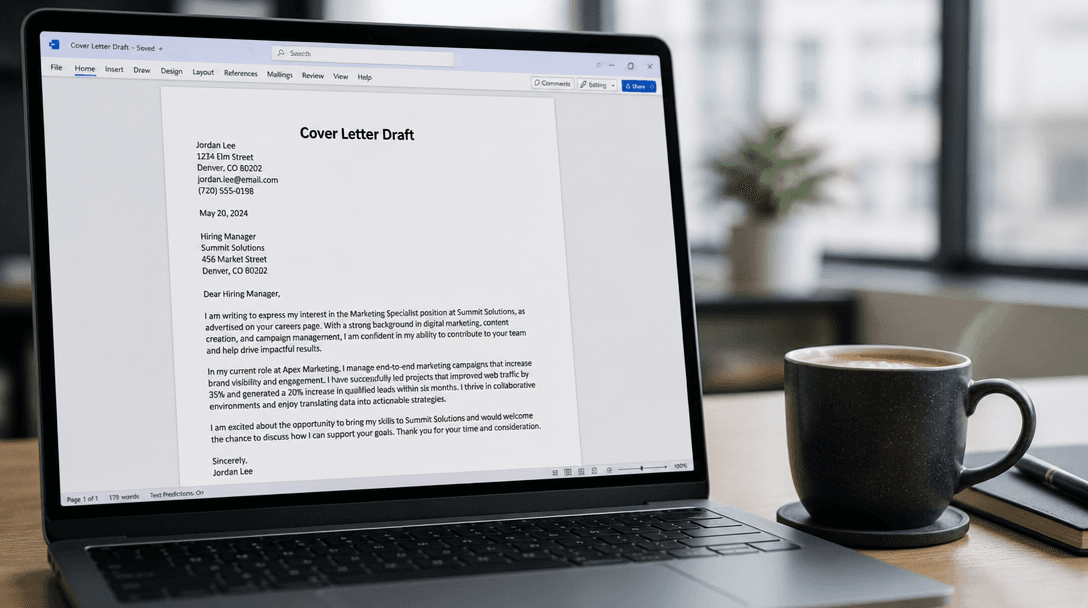
Most jobs in Tamil Nadu - especially manufacturing walk-ins and IT mass hiring - don't require cover letters. You show up with your resume, attend the interview, and that's the process. But occasionally, a company's job listing says "please send your resume along with a cover letter" or the online application has a field for "cover letter or message to the recruiter." When that happens, submitting an application without a cover letter puts you at a disadvantage against candidates who included one.
A cover letter isn't another resume. It's a one-page letter that explains three things: why you're applying to this specific company, why you're a good fit for this specific role, and what you can bring that your resume alone doesn't convey. Done well, it takes 30 minutes to write and significantly improves your chances. Done poorly, it wastes everyone's time - including yours.
When You Actually Need a Cover Letter
Write a cover letter when the job listing explicitly asks for one. This seems obvious, but many candidates ignore this requirement, assuming their resume is sufficient. If the company asks for a cover letter and you don't provide one, you've failed the first test - following instructions.
Write one when applying via email. If you're sending your resume by email (to an HR email address you found on the company's website or received from a contact), the email body itself should function as your cover letter. A blank email with just an attached resume looks lazy. Your email body should be a concise cover letter that makes the HR manager want to open the attachment.
Write one when applying to mid-sized or large companies through their careers portal. Companies like Cognizant, L&T, Bosch, and similar companies with structured application processes often have cover letter fields. Filling this field distinguishes you from the majority of applicants who leave it blank or paste their resume text into it.
Skip the cover letter for manufacturing walk-ins, mass recruitment drives, and staffing agency registrations. These processes are designed for volume and speed - nobody reads cover letters in a walk-in queue. Your resume and in-person interview do the talking.
Person writing a cover letter at a clean desk with reference materials
The Three-Paragraph Formula That Works
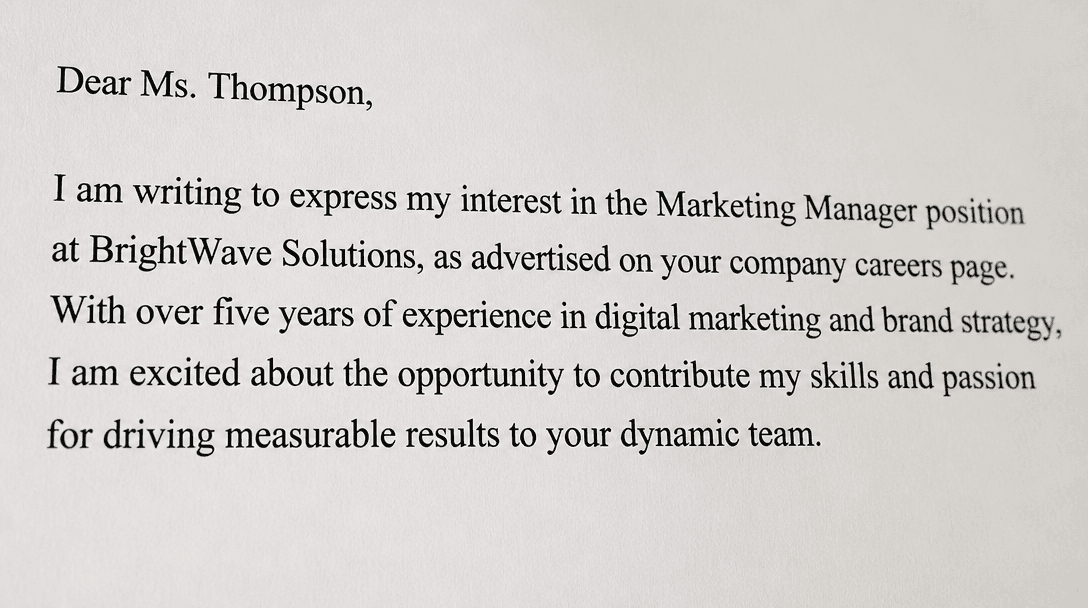
Paragraph 1 - The Hook (3-4 sentences): State the specific role you're applying for, where you saw the listing, and one sentence about why this company interests you. Be specific: "I am writing to apply for the Graduate Engineer Trainee (Mechanical) position listed on your careers portal. Your company's work in precision automotive components for Hyundai and Renault aligns with my diploma training in manufacturing processes, and I am eager to contribute to your production team."
This opening paragraph does heavy lifting: it identifies the exact role (so the HR person can route your application correctly), demonstrates you know what the company does (showing research), and connects your background to their work (showing relevance). Three sentences that check three boxes.
Paragraph 2 - Your Fit (4-5 sentences): This is where you expand on why your specific skills and experiences make you suitable for this role. Don't repeat your resume - add context and connection. "During my three-year diploma at XYZ Polytechnic, I focused on manufacturing processes and quality control, completing 1,200+ hours of practical training. My final-year project on reducing cycle time in drilling operations gave me hands-on experience with process improvement - an area I understand your company prioritises. I also completed a short-term certification in CNC programming from NSDC, which I believe is relevant to your automated production lines."
Notice the pattern: skill → evidence → connection to the company. Each sentence links something about you to something about the company. This makes the HR manager think "this person understands what we need" rather than "this person is sending generic applications everywhere."
Paragraph 3 - The Close (2-3 sentences): Express enthusiasm, state your availability, and thank them. "I am available for immediate joining and am open to any shift schedule. I would welcome the opportunity to discuss how my training and skills can contribute to your team. Thank you for considering my application - I look forward to hearing from you." Clean, professional, no drama.
Ready-to-Use Cover Letter Template
Here's a complete template. Replace the bracketed sections with your own information.
[Your Name]
[Your Phone Number] | [Your Email]
[Your City, State]
[Date]
To,
The HR Manager,
[Company Name],
[Company Location]
Subject: Application for [Exact Position Name] - [Your Name]
Dear Sir/Madam,
I am writing to apply for the [position name] role at [company name], as advertised on [source - company website/LinkedIn/newspaper]. [One sentence about why this company specifically interests you - reference their product, industry position, or something specific you know about them].
[2-3 sentences about your qualification, practical training, and specific skills relevant to this role. Include your project work or any hands-on experience. Connect your background to the company's needs - mention their product, technology, or work area and how your training aligns with it].
I am available for immediate joining and am flexible regarding work schedules. I have attached my resume for your reference and would be happy to provide any additional information. Thank you for your time and consideration.
Yours sincerely,
[Your Full Name]
[Phone Number]
This template is 200-250 words - the ideal length. Long enough to say something meaningful, short enough to be read completely. Adjust the content for each application while keeping the structure constant.
Mistakes That Make Your Cover Letter Work Against You
Writing a generic letter that you send to every company unchanged. If your cover letter doesn't mention the company name, the specific role, or anything that connects your background to their needs, it's obvious you're mass-sending applications without any research. A generic cover letter is worse than no cover letter because it actively demonstrates a lack of effort.
Repeating your resume in paragraph form. Your cover letter adds context, connection, and personality that a resume can't. If you simply convert your resume bullet points into sentences, you've doubled the HR manager's reading load without adding any new information.
Using overly formal or flowery language. "I humbly beg to submit my candidature for your esteemed consideration" or "It would be an immense honour and privilege to be a part of your prestigious organisation." This language sounds insincere and outdated. Write like a professional, not like a colonial-era petition writer. Clear, direct language always outperforms ornate phrasing.
Including salary expectations in the cover letter unless specifically asked. Mentioning salary before the company has decided they want you shifts the conversation to money before they've evaluated your fit. If the application form asks for salary expectations, fill that field. Otherwise, save salary discussion for the interview.
Exceeding one page. A cover letter is not an essay. If you can't make your case in 200-300 words, you're including unnecessary information. No HR manager reads a two-page cover letter from a fresher. Keep it concise, focused, and complete on one page - ideally the top two-thirds of a page, leaving comfortable margins.
Build a Reusable Library
Save every cover letter you write in a folder organised by company name. When you apply to a similar company in the same industry, you can customise your previous letter rather than writing from scratch. Over time, you'll have a collection of proven cover letter variations for different sectors - manufacturing, IT, service - that you can adapt in 10 minutes instead of spending 30 minutes starting from zero. This approach makes applying to multiple companies faster without sacrificing the personalisation that makes cover letters effective.