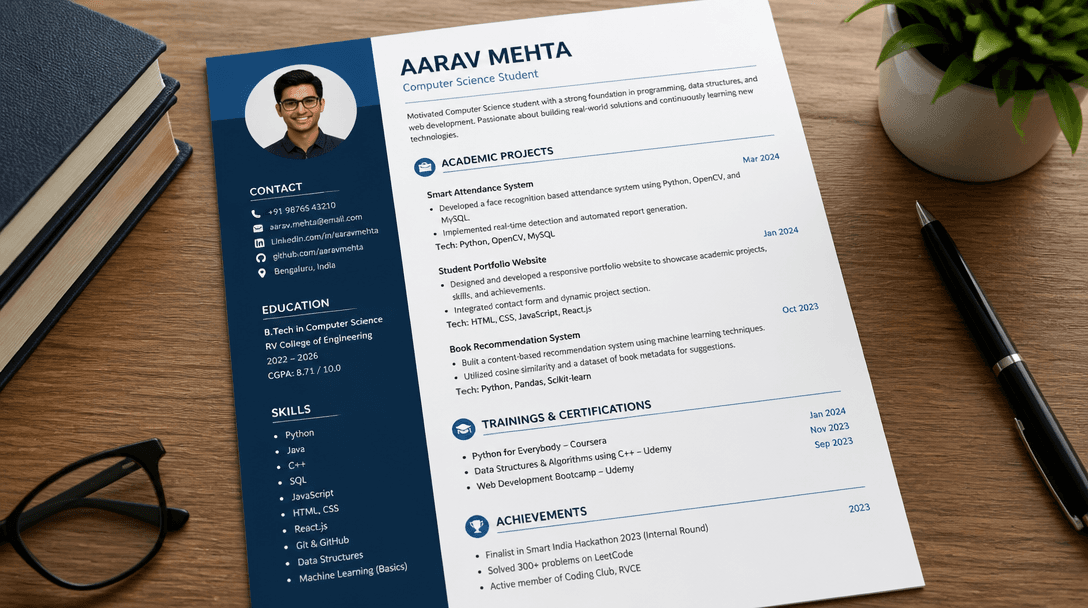
Staring at a blank resume template when you have zero work experience is one of the most demoralising moments in a fresher's job search. Every section seems to require something you don't have - work history, professional achievements, industry experience. The temptation to either fabricate experience or submit a half-empty resume is strong. Neither works. Fake experience collapses under basic verification. A sparse resume suggests you have nothing to offer.
The truth is that a fresher with no work experience still has content for a strong, one-page resume. You just need to know where to find it and how to present it. Here's how to build a resume that's honest, complete, and compelling - without inventing a single thing.
You Have More Experience Than You Think
The word "experience" in the context of a resume doesn't exclusively mean paid employment. It means any situation where you applied skills, solved problems, or produced results. As a student, you've done all of these - you just haven't framed them professionally yet.
Your practical training counts. Every ITI student completes 2,000+ hours of workshop practice. Every diploma student completes lab sessions, industrial visits, and practical examinations. Every engineering student does a final-year project and usually an internship. These are experiences where you applied technical knowledge in hands-on settings. They belong on your resume - prominently.
Your project work counts. Even if your project was a college requirement that every student in your batch did, the specific project you completed is unique to you. The problem you addressed, the approach you took, the results you achieved - these are demonstrable applications of your skills. Frame them with specific details, not vague descriptions.
Volunteering, event organisation, and club activities count - if they demonstrate relevant skills. If you helped organise a college technical symposium, you demonstrated coordination, planning, and execution. If you volunteered at an NGO, you demonstrated initiative and social responsibility. The key is connecting these activities to workplace-relevant competencies, not just listing them as filler.
Part-time or informal work counts. Did you help in a family business? Tutor younger students? Do data entry work during college? Handle accounts for a local shop? These experiences demonstrate reliability, responsibility, and practical skills. Frame them as professional experiences, even if they were informal: "Managed daily accounts and inventory for a family retail shop (2023-2024), handling ₹50,000+ in daily transactions."

Notebook with resume content ideas brainstormed by a fresher
How to Present Your Education as Experience
When work experience is absent, your education section needs to do heavier lifting than a simple list of institutions and percentages. Here's how to make it work harder.
Expand your project descriptions. Instead of: "Final year project: Temperature monitoring system." Write: "Final Year Project: Automated Temperature Monitoring System - Designed and built a real-time temperature monitoring system using Arduino Uno microcontroller and LM35 sensor. Programmed data logging functionality in C++ to record temperature readings every 30 seconds. Tested the system across a 0-100°C range with ±1°C accuracy. Presented findings to a faculty panel of 4 professors."
The second version takes more space but communicates technical capability, attention to precision, and the ability to present work - all things an employer values. You've turned two lines of education into a demonstration of applied skills.
Mention relevant coursework. If you're applying for a quality control role and you studied Statistical Quality Control as part of your diploma, mention it. "Relevant Coursework: Statistical Quality Control, Manufacturing Processes, Material Science, Engineering Drawing, CNC Technology." This tells the employer that your academic foundation aligns with the role - something they can't assess from your percentage alone.
Include academic achievements selectively. Class rank (if top 10%), subject-specific awards, competition wins, and semester toppers - these signal capability even without work experience. Don't list achievements that aren't impressive - "participated in a quiz" isn't worth the space. "Won second place in a state-level technical quiz on manufacturing processes" is.
The Skills Section - Your Most Powerful Weapon
For freshers without work experience, the skills section becomes the most important part of the resume after education. But it needs to be structured strategically, not listed randomly.
Divide skills into categories. For a manufacturing fresher: Technical Skills (machines, tools, processes), Software Skills (CAD, office tools, programming), and Soft Skills (communication, teamwork - but only if you can back them with examples). Categorising skills shows organisation and helps the HR manager quickly find the specific skills they're looking for.
Use specifics, not generalities. Wrong: "Good at computers." Right: "Proficient in AutoCAD 2D (200+ hours during coursework), MS Excel (pivot tables, VLOOKUP), and basic Python programming." Wrong: "Welding skills." Right: "Arc welding (SMAW) - completed 120 hours of practical training including flat, horizontal, and vertical position welding with 6013 and 7018 electrodes."
Match skills to the job listing. If the job advertisement mentions specific skills - CNC operation, quality inspection, PLC programming - and you have those skills, make sure they appear prominently in your skills section using the exact terminology from the listing. HR screening software (and human screeners) look for keyword matches between the job requirement and your resume.
Be honest about proficiency levels. If you're "basic" in something, say basic. If you're "proficient," say proficient. Manufacturing companies test technical claims during interviews - claiming proficiency in CNC programming when you've only completed a short awareness course will be exposed during a practical test. Honesty about your current level, combined with willingness to learn, is always better received than inflated claims.
Filling the Page Without Padding or Lying
Here are additional resume sections that legitimately fill space with real content, specifically for freshers.
Internship or industrial visit details: Even a one-day industrial visit to a manufacturing plant is worth mentioning if you describe what you observed and learned: "Industrial Visit: Hyundai Motor India, Sriperumbudur (2024) - Observed the automated assembly line process including body welding, paint shop, and quality inspection stations. Understood the role of kanban systems in production scheduling." Two sentences that demonstrate practical awareness and genuine interest in manufacturing processes.
Workshops and seminars attended: "Attended a 3-day workshop on CNC Programming Basics at Anna University (2024)" or "Participated in a seminar on Industry 4.0 and Smart Manufacturing at PSG College of Technology (2025)." These show proactive interest in learning beyond the curriculum.
Languages: In Tamil Nadu's job market, your language profile is relevant. "Tamil (native), English (functional working proficiency), Hindi (basic)" - this tells the employer about your communication capabilities. For companies that deal with clients or branches in other states, multilingual ability is a genuine asset.
Declaration: End with a standard declaration: "I hereby declare that the above information is true to the best of my knowledge and belief." Sign it with your name, city, and date. This is standard for Indian resumes and adds a professional touch that shows you understand formal documentation.
Your Potential Is the Point
Every experienced professional once had a resume with zero work experience. The resume that got them their first job wasn't impressive because of what it contained - it was effective because of how well it communicated the candidate's potential. Your resume's job isn't to prove you're experienced - it's to prove you're prepared, capable of learning, and serious about the opportunity. Communicate those three things clearly on one page, and your zero-experience resume will perform better than experienced resumes that are poorly written.