Manufacturing HR managers in Tamil Nadu spend an average of 30-45 seconds on each resume during a walk-in screening. In those seconds, they need to see your trade, your qualification level, and whether you match the basic requirements of the role. If your resume makes them search for this information - buried under paragraphs of text, hidden in a creative layout, or formatted like an IT professional's portfolio - it goes to the bottom of the pile.
Manufacturing resumes follow different rules than IT or corporate resumes. The format is simpler, the priorities are different, and the information that matters most is specific to the factory floor. Here's how to create one that works.
The Right Resume Format for Manufacturing Jobs
Use a reverse-chronological format - most recent qualification first, then working backward. Keep it to one page. Manufacturing HR managers told me repeatedly that two-page resumes from freshers signal either padding or poor prioritisation. Everything a fresher needs to communicate fits on one page if you write efficiently.
Choose a clean, sans-serif font like Arial, Calibri, or the Tamil Nadu favourite, Times New Roman. Font size 11 or 12 for body text, 14 for your name, and 12-13 bold for section headings. Use consistent formatting - if one heading is bold, all headings are bold. If one date is right-aligned, all dates are right-aligned. Inconsistent formatting looks careless, and manufacturing companies value consistency.
Margins of 1 inch on all sides. Don't shrink margins to fit more text - shrinking margins below 0.75 inches makes the page look cramped and is harder to read. If your content doesn't fit, cut unnecessary details rather than squeezing the layout.
Save and submit as PDF unless specifically asked for a Word document. PDFs maintain formatting across different devices and printers. A beautifully formatted Word resume that becomes a jumbled mess when the HR team opens it on their computer defeats the purpose of formatting.
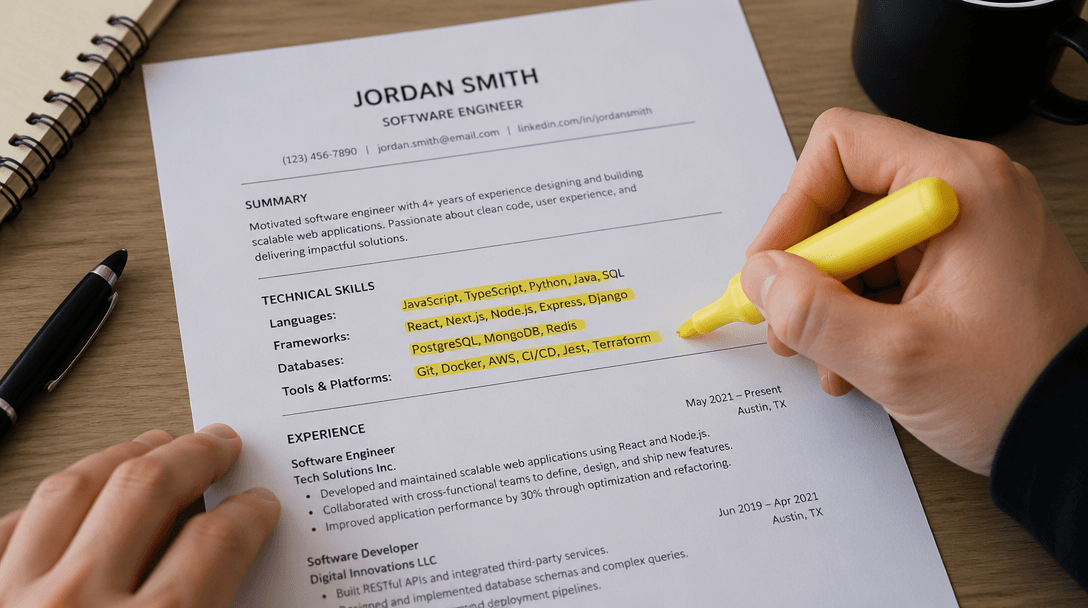
Sample Tamil Nadu manufacturing resume with highlighted technical skills
What to Include - Section by Section
Header section: Your full name (larger font, bold), phone number, email address, and city/district. Don't include your full postal address - it's unnecessary and takes up space. Don't include date of birth, father's name, gender, or marital status on the resume itself. These details are collected on the company's application form if needed - your resume is a professional document, not a biodata.
Career objective (2 lines maximum): For manufacturing resumes, this section should be direct and specific: "Seeking an entry-level production/quality/maintenance role in a manufacturing environment where I can apply my ITI Fitter training and contribute to production targets." Customise the role type and trade to match the specific position you're applying for. Avoid generic objectives like "seeking a challenging position to utilise my skills" - this tells the HR manager nothing useful.
Education and qualifications: List in reverse chronological order. For each entry: Qualification name | Institution name, City | Year of completion | Percentage or CGPA. For ITI holders, include your trade name prominently: "ITI in Fitter Trade - Government ITI, Salem - 2025 - 78%". For diploma holders, mention your specialisation: "Diploma in Mechanical Engineering - XYZ Polytechnic, Coimbatore - 2025 - 72%". Your trade or specialisation is the single most important piece of information on your resume for manufacturing jobs.
Technical skills: List your practical skills in a bulleted format. For manufacturing, this means: machines you can operate (lathe, milling, drilling, CNC), tools you're proficient with (vernier caliper, micrometer, dial gauge), processes you've trained in (welding, grinding, surface finishing), and any software (AutoCAD, SolidWorks, CNC programming). Be honest - list only skills you can demonstrate if tested. Claiming CNC programming when you've only watched a demonstration will backfire when they put you in front of a machine.
Projects or practical training: Describe your final project or major practical training in 2-3 lines. Use this format: Project title → What you did → What the outcome was. Example: "Final Project: Design and fabrication of a pneumatic sheet cutting machine - designed the pneumatic circuit, fabricated the frame using mild steel, and tested cutting accuracy on aluminium sheets up to 2mm thickness. Achieved cutting precision of ±0.5mm." This demonstrates hands-on capability, which is exactly what manufacturing companies want to see.
Certifications (if any): List any additional certifications: CNC programming, Six Sigma, quality inspection, safety training, first aid. Include the issuing organisation and year. Even short-term certifications (weekend workshops, online courses) are worth listing if they're relevant to manufacturing.
Complete Example Resume for a Manufacturing Fresher
Here's a complete resume example for an ITI Fitter fresher applying for a production operator role. Use this as a template - replace the details with your own information.
RAJESH KUMAR M
Mobile: +91-98765 43210 | Email: rajesh.kumar@email.com | Salem, Tamil Nadu
CAREER OBJECTIVE
Seeking an entry-level production operator role in a manufacturing company where I can apply my ITI Fitter training in assembly, machining, and quality inspection to contribute to production targets.
EDUCATION
ITI in Fitter Trade | Government ITI, Salem | 2025 | 82%
HSC (12th) | Government Higher Secondary School, Mettur | 2023 | 71%
SSLC (10th) | Government High School, Mettur | 2021 | 85%
TECHNICAL SKILLS
• Lathe operation: turning, facing, threading, knurling
• Bench fitting: filing, drilling, tapping, reaming
• Measurement instruments: vernier caliper, micrometer, height gauge, dial indicator
• Welding awareness: basic arc welding (attended 2-week workshop)
• Reading and interpreting engineering drawings
• Basic CNC awareness (NSDC short-term course, 2025)
PROJECT
V-Block Fabrication and Assembly (ITI Final Practical)
Fabricated a precision V-block using filing, drilling, and grinding operations. Maintained dimensional accuracy within ±0.05mm tolerance. Completed within the allotted time with zero rework.
CERTIFICATIONS
• CNC Awareness Programme - NSDC Centre, Salem - 2025
• Basic Computer Skills (MS Office) - Government Skill Centre - 2024
LANGUAGES
Tamil (native) | English (functional working proficiency)
This resume is exactly one page, clearly structured, and highlights everything a manufacturing HR manager needs to see within 30 seconds: trade (Fitter), practical skills (lathe, fitting, measurement), project work (demonstrating accuracy), and additional certifications (CNC, computer skills).
Format Mistakes That Get Manufacturing Resumes Rejected
Using a "creative" or graphical resume template. Manufacturing companies process hundreds of resumes through basic document management systems and sometimes through ATS (Applicant Tracking Systems). Fancy designs with columns, icons, skill bars, and colour blocks often don't parse correctly. Your resume ends up looking like garbled text in their system. Stick to a single-column, text-based layout.
Including a selfie as your resume photo. If you choose to include a photo (it's optional for most manufacturing roles), use a professional passport-size photograph. Not a cropped selfie, not a group photo with you circled, not a photo with a filter. A plain photograph against a white or light background, wearing a formal shirt, looking directly at the camera.
Writing in paragraph form instead of bullet points. HR managers scanning 200 resumes don't read paragraphs. They scan bullet points. Convert every section that lists information - skills, certifications, education - into bulleted or structured format. Save paragraph writing for the project description and career objective only.
Listing irrelevant hobbies. "Playing cricket, listening to music, watching movies" adds zero value to a manufacturing resume. If your hobby is directly relevant - "building and repairing electronic circuits as a hobby" for an electronics manufacturing role - include it. Otherwise, omit the hobbies section entirely and use that space for something useful.
Using an unprofessional email address. "coolguy_rajesh@gmail.com" or "rockstar_kumar@yahoo.com" undermine your professional image. Create a simple email: firstname.lastname@gmail.com or firstnamelastname@gmail.com. This takes two minutes and makes a meaningful difference in how your resume is perceived.
Get a Second Pair of Eyes
Before submitting your resume anywhere, have someone else read it - a friend, a family member, or a mentor. Ask them two questions: "Can you tell what job I'm looking for within five seconds of looking at this?" and "Is there any spelling or formatting error you can spot?" Fresh eyes catch mistakes that yours miss after hours of staring at the same document. One spelling error in a resume is forgivable; three suggest carelessness - and carelessness is the opposite of what manufacturing companies hire for.