Most resume advice online is written for degree holders applying to corporate jobs. When you try to apply that advice to an ITI or diploma resume, it doesn't work - the format feels wrong, the emphasis is misplaced, and the language sounds like it belongs on a management trainee application rather than a production technician's. ITI and diploma qualifications are practical, hands-on credentials. Your resume needs to reflect that reality.
Manufacturing companies hiring ITI and diploma holders are looking for specific information that's different from what they look for in degree-level candidates. They want to know your trade, your practical capabilities, and whether you can hit the ground running on a factory floor. Here's how to build a resume that answers those questions immediately.
Why ITI and Diploma Resumes Need Different Priorities
When a company hires a B.E graduate, they're often hiring for potential - the assumption is that training will shape the graduate into the role. When they hire an ITI or diploma holder for a manufacturing position, they're hiring for capability. They expect you to have hands-on skills from your practical training that can be applied to production tasks relatively quickly.
This means your resume's priority order should be: Trade/Specialisation → Practical Skills → Project/Training Details → Education → Certifications. Notice that education comes after skills - not because education doesn't matter, but because for a manufacturing employer scanning your resume, knowing you're an "ITI Fitter with lathe, drilling, and CNC awareness" is more useful than knowing your percentage first.
Many ITI and diploma holders make the mistake of structuring their resume like a degree-level one - education block first, then a sparse skills section, then hobbies to fill space. This buries the most relevant information (your trade skills) below the least relevant (your 10th standard marks). Restructure so your strongest selling points appear in the top half of the page, where the HR manager's eyes go first.

Technical skills checklist relevant to ITI trade qualifications
Trade-Specific Formatting That Gets Noticed
Your trade identity should be visible within the first three seconds of someone looking at your resume. Here's how to achieve that.
Directly under your name and contact details, add a one-line trade identifier in bold: "ITI FITTER | CNC Awareness Certified | Seeking Production/Maintenance Roles" or "DIPLOMA IN MECHANICAL ENGINEERING | Quality Control Focus | Available for Immediate Joining." This line acts as a headline that immediately tells the screener who you are professionally. It's the manufacturing resume equivalent of a LinkedIn headline.
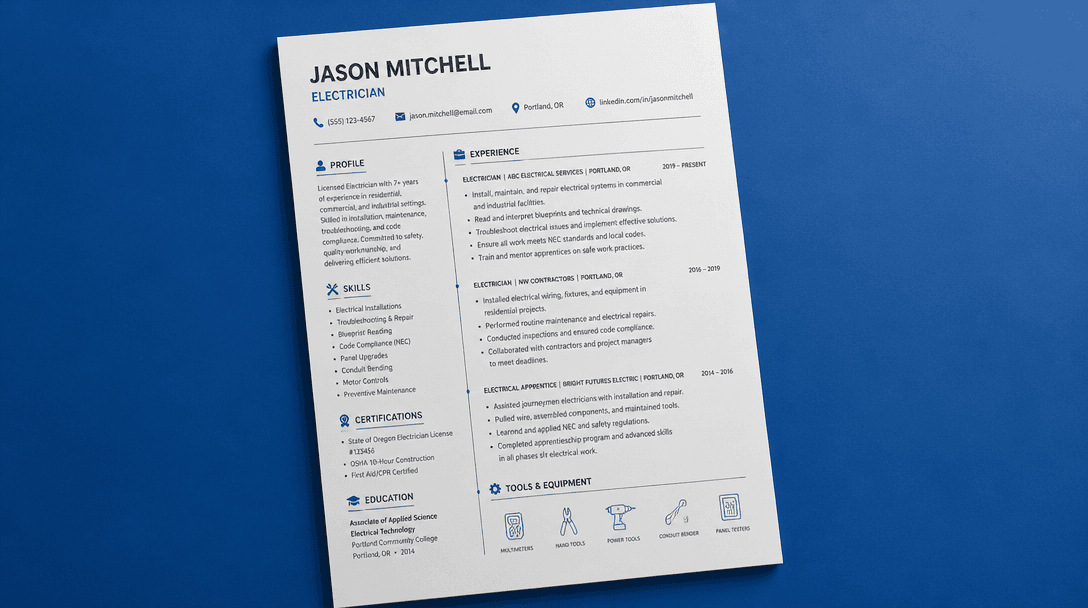
In your skills section, organise by skill type relevant to your trade. For an ITI Electrician: Electrical Installation (domestic wiring, industrial panel wiring, earthing), Testing and Measurement (megger, multimeter, tong tester, earth resistance tester), Motor Skills (single-phase and three-phase motor winding, starter connections), and Safety (electrical safety protocols, PPE usage, lockout-tagout awareness). This trade-specific grouping shows depth rather than a random list of buzzwords.
For diploma holders, include your specialisation focus area. A mechanical diploma covers broad ground - from thermodynamics to machine design. But you likely had areas where you performed strongest or had the most practical exposure. "Specialisation focus: Manufacturing Processes, CNC Technology, Quality Control" or "Strong areas: Power Systems, Electrical Machines, PLC Programming." This helps HR match you to the right department rather than treating you as a generic diploma candidate.
Putting Practical Skills Front and Centre
The practical training you completed during your ITI or diploma is your biggest resume asset. Most freshers understate it. Here's how to present it effectively.
Quantify your practical hours. "2,000+ hours of workshop training" (standard for a 2-year ITI course) or "1,200+ hours of lab and workshop practice" (typical for a 3-year diploma) puts a number on your hands-on experience. It's particularly effective when an HR manager is comparing you against a degree holder who might have fewer practical hours despite a longer course duration.
List machines and equipment you've operated - be specific about models if you remember them. "Operated: Centre Lathe (Kirloskar), Radial Drilling Machine, Surface Grinder, Universal Milling Machine, CNC Turning Centre (FANUC controller)." Specific machine names and controller types tell employers you've used real industrial equipment, not just textbook illustrations.
Describe your practical exam or final project as if it were a work assignment. Instead of "Practical exam: Made a V-block," write "Precision V-Block Fabrication: Manufactured a precision V-block from MS flat using filing, drilling, and grinding operations. Maintained all dimensions within ±0.05mm tolerance. Completed within 8-hour time limit with zero rework required." This reads like a work accomplishment, which is exactly the mindset shift your resume needs.
Include any real-world exposure during training. Many ITI and diploma programmes include factory visits, on-the-job training (OJT), or apprenticeship components. Detail these: "On-the-Job Training: 3 months at Sundaram Brake Linings, Chennai - worked in the quality inspection department, learned to use coordinate measuring machine (CMM) for brake component inspection, and observed production planning procedures." Real-world exposure, even brief, is gold on a fresher's resume.
What to Skip - Saving Space for What Matters
Every line on a one-page resume is valuable real estate. Here's what to remove to make room for high-impact content.
Remove the "hobbies" section entirely unless a hobby is directly relevant to the job. Playing cricket and listening to music - the two most common hobbies listed on Tamil Nadu resumes - tell an employer nothing about your professional capability. Use that space for an additional certification, a more detailed project description, or a language proficiency section instead.
Remove "references available upon request." This is implied. No one will refuse to provide references when asked. The line wastes space without adding information.
Remove your full postal address. Your city and state are sufficient. A complete address with pin code serves no purpose on a resume - communication happens by phone and email, not by postal mail.
Remove your 10th and 12th marks if they're lower than your ITI/diploma marks. If you scored 85% in your trade but 55% in your 10th standard, including the 10th marks only creates a point of concern. Your most recent and relevant qualification is what matters. If an employer specifically asks for earlier marks during the interview or application form, provide them then.
Remove vague objective statements. "To work in a challenging environment that provides growth opportunities" - this could apply to literally any job in any industry. Either write a specific, targeted career objective or skip the section entirely and use the space for something substantive.
Get It Reviewed Before You Send
Print two copies of your final resume and ask two different people to review them - one person who understands your trade (a classmate, instructor, or senior from your field) and one person who doesn't (a family member or friend from a different background). The trade person checks if your technical descriptions are accurate and complete. The non-trade person checks if the resume is easy to read and understand. A resume that passes both reviews is ready for submission - it's technically sound and professionally clear, which is exactly the combination that gets ITI and diploma holders shortlisted.