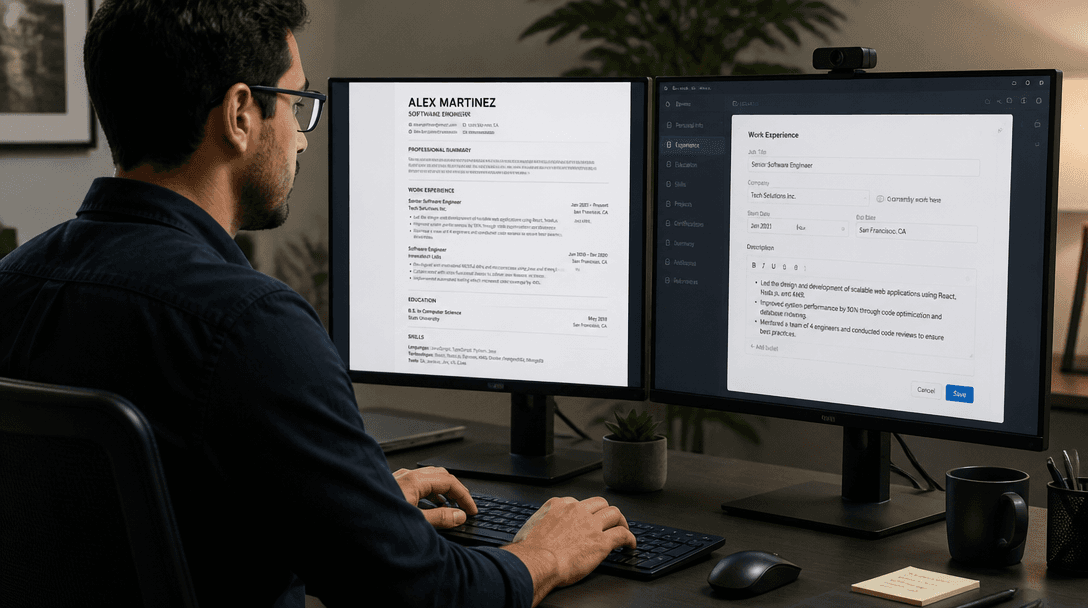
You've completed your first year (or six months, or two years) at your first job. Whether you're planning to stay or starting to look at your next opportunity, your resume needs to evolve from a fresher document to a professional one. The resume that got you hired is no longer the resume that represents you. You've learned things, done things, and achieved things that didn't exist on that original page. Your updated resume should reflect who you are now, not who you were when you had zero experience.
The update process isn't just about adding your job to the experience section. It's about restructuring the entire document to lead with your professional experience rather than your academic background. Here's how to make that transition cleanly.
What Changes Now That You Have Experience
The fundamental structure of your resume shifts. As a fresher, education was your primary section - it appeared first and got the most space. Now, your work experience takes the top position, right below your contact details and professional summary. Education moves down to a supporting role. This isn't about devaluing your education - it's about leading with your most relevant and impressive credential, which is now your real-world work experience.
Your objective statement transforms into a professional summary. The fresher objective ("seeking an entry-level role where I can apply my training") no longer applies - you're no longer entry-level, and you're no longer seeking to apply training. You've already applied it. Replace it with a summary that captures who you are professionally: "Production Technician with 1.5 years of experience in automotive component manufacturing. Skilled in CNC operations, quality inspection using CMM, and lean manufacturing practices. Achieved 99.2% quality compliance rate in Q3 2025."
Your skills section becomes evidence-based rather than claim-based. As a fresher, you listed skills you learned in college. Now, you list skills you've used professionally. The difference is credibility: "CNC Operation (FANUC controller, 18 months production experience)" carries more weight than "CNC Operation (trained during ITI)." Update every skill entry to reflect professional usage, not just academic exposure.
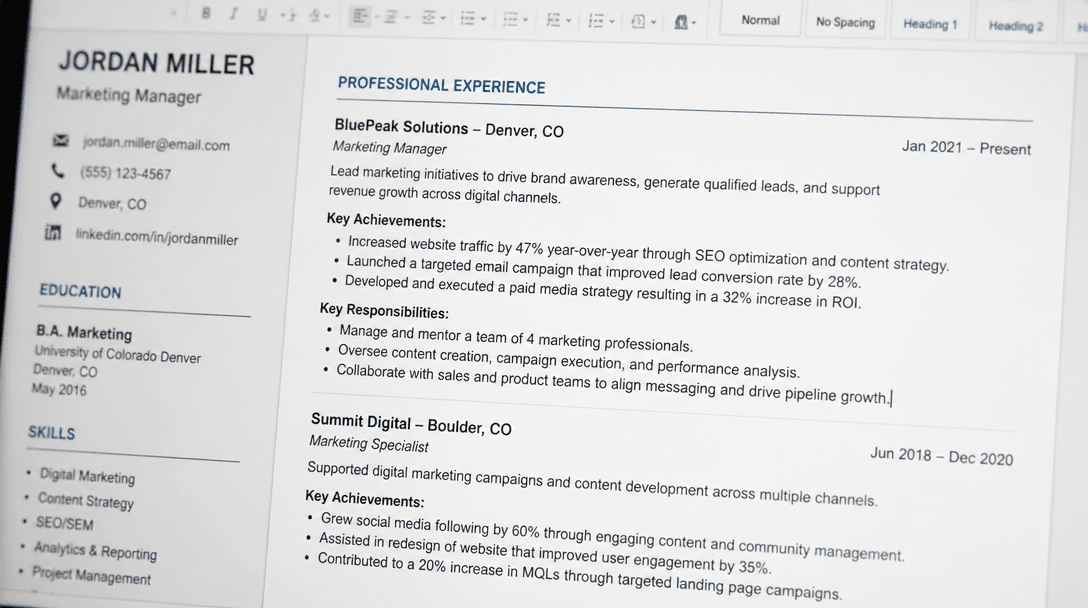
Resume layout showing professional work experience positioned above education
How to Describe Your First Role Effectively
The experience section is where most people stumble during their first resume update. They either write too little ("Worked as Production Operator at XYZ Company") or too much (a paragraph describing every daily task). The sweet spot is 4-6 bullet points that cover what you did, how you did it, and what you achieved.
Start each bullet point with an action verb. "Operated CNC turning centre..." "Maintained quality standards..." "Reduced setup time by..." "Trained three new operators on..." Action verbs communicate initiative and impact. Passive descriptions ("was responsible for quality checking") communicate passivity.
Quantify whenever possible. Manufacturing and IT roles generate measurable outputs - use them. "Operated CNC turning centre producing 150+ components per shift with 98% first-pass quality" is dramatically stronger than "Operated CNC machine." "Resolved an average of 45 customer support tickets daily" is better than "Handled customer queries." Numbers make your contributions tangible and give the next employer a benchmark of your capability.
Highlight achievements, not just duties. Your job description lists your duties - the next employer can look that up for any similar role. What they can't look up is what you specifically achieved. Did you suggest a process improvement? Quantify it: "Suggested fixture modification that reduced component changeover time by 12 minutes, saving approximately 2 hours per shift." Did you get promoted or take on additional responsibility? "Promoted from Operator to Senior Operator within 10 months based on consistent quality performance and zero unexcused absences." Did you train others? "Trained and mentored 5 new operators on assembly line procedures during Q2 2025."
What If Your First Job Was Routine With No Big Achievements
Not every first job involves dramatic improvements or promotions. If your role was straightforward - operating a machine, handling data entry, answering calls - focus on consistency and reliability metrics. "Maintained 100% attendance for 8 consecutive months." "Processed 200+ data entries daily with 99.5% accuracy." "Met production targets for 12 consecutive months." Consistency is itself an achievement in manufacturing and service roles, and quantifying it makes it resume-worthy.
What to Remove from Your Fresher Resume
Your career objective statement - replace it with a professional summary as described above. The objective was appropriate when you had no professional identity; the summary is appropriate now that you do.
Detailed 10th and 12th standard marks - unless they were exceptional (90%+). Your professional experience now carries more weight than your school exam performance. Keep the education entries (they're still needed for verification) but reduce them to one line each: institution, qualification, year, percentage.
Your college project description - if your work experience is now more relevant. As a fresher, your project was your strongest demonstration of capability. Now, your actual work accomplishments serve that purpose. If your project is still relevant to the type of role you're seeking next, keep a condensed version. If not, remove it to make space for your experience section.
Skills that you listed as a fresher but never used professionally. If you listed "Python" on your fresher resume because of one semester course, but your first job was entirely mechanical and you haven't touched Python since, remove it. Your skills section should now reflect what you can actually do in a professional context, verified by your experience.
The declaration section - it was borderline necessary as a fresher in Tamil Nadu's hiring culture, but it's completely unnecessary once you have professional experience. The space is better used for another achievement bullet point or a relevant certification.
Positioning Your Resume for Your Next Move
Your updated resume should answer one question for the next employer: "What can this person do for us based on what they've already done?" Every element of the resume should contribute to answering this question.
Tailor your professional summary to the type of role you want next, not the role you had. If you were a production operator and want to move into quality control, your summary should emphasise quality-related aspects of your production experience: "Production Operator with 1.5 years of experience and a strong focus on quality compliance. Maintained 99.2% first-pass quality rate across 150+ daily components. Seeking to transition into a dedicated Quality Inspection role."
Reorder your experience bullet points to emphasise what's most relevant to your target role. If you're applying for a supervisory position, lead with bullet points about training others, coordinating shift activities, and taking initiative. If you're applying for a technical specialist role, lead with bullet points about specific technical skills, problem-solving, and process improvement.
Add a "Key Achievements" or "Highlights" section at the top - two to three bullet points that capture your strongest professional accomplishments. This gives the HR manager your best material first, before they even reach the detailed experience section. "Promoted to Senior Operator in 10 months" or "Achieved zero quality rejections for 6 consecutive months" - these headlines create interest that pulls the reader through the rest of your resume.
Start a Brag Document
Start maintaining a "brag document" - a running list of everything you accomplish at work. Every time you meet a target, receive appreciation, complete a training, solve a problem, or take on new responsibility, add it to this document with the date and any relevant numbers. When it's time to update your resume (every 6 months is a good rhythm), you have a rich source of material to draw from instead of trying to remember achievements from months ago. The brag document turns resume updating from a stressful exercise in memory recall into a simple exercise in selecting and formatting your best work.