You've finished your degree, diploma, or ITI course. You sit down to write your resume's skills section and immediately hit a wall. What are your skills, exactly? You know you studied things. You passed exams. You completed practical sessions. But translating three years of education into a concise list of "skills" that an employer cares about feels abstract and uncertain.
The problem isn't that you don't have skills - you have more than you realise. The problem is that nobody taught you how to identify and articulate them in the language that employers understand. Here's how to bridge that gap.
How to Find Skills You Didn't Know You Had
Start with your curriculum, not your memory. Open your course structure or syllabus (every college has this on their website or in the handbook). Go through each subject and lab course. For each one, ask: "What can I do because I studied this?" Not "what do I remember from this" - that's knowledge. But "what can I do" - that's a skill.
For example, if you studied "Manufacturing Processes" in your diploma, the skills gained include: understanding of casting, forging, welding, and machining processes; ability to select appropriate manufacturing methods for different materials; reading and interpreting engineering drawings for production. Each of these is a legitimate, listable skill that a manufacturing employer values.
Think about your practical sessions separately from theory. Your lab work and workshop sessions produced different skills than your classroom learning. Operating a lathe is a skill. Using a multimeter is a skill. Running a simulation in MATLAB is a skill. Writing SQL queries in a database lab is a skill. Go through your lab manuals and list every tool, software, or process you used hands-on. These practical skills often matter more to employers than theoretical knowledge.
Consider transferable skills from non-academic activities. Did you manage a college event? That's project coordination. Did you lead a study group? That's team leadership. Did you work part-time during college? That's time management and multitasking. Did you learn something through YouTube tutorials beyond your coursework? That's self-directed learning and initiative. These soft skills are genuine competencies that complement your technical skills.
Ask someone who knows you. Sometimes you're too close to your own abilities to see them clearly. Ask a classmate, professor, or family member: "What do you think I'm good at?" Their external perspective often highlights skills you take for granted because they come naturally to you. If three people independently say "you're really good at explaining complex things simply," that's a communication skill worth listing.
Skills checklist organized by category on a notepad
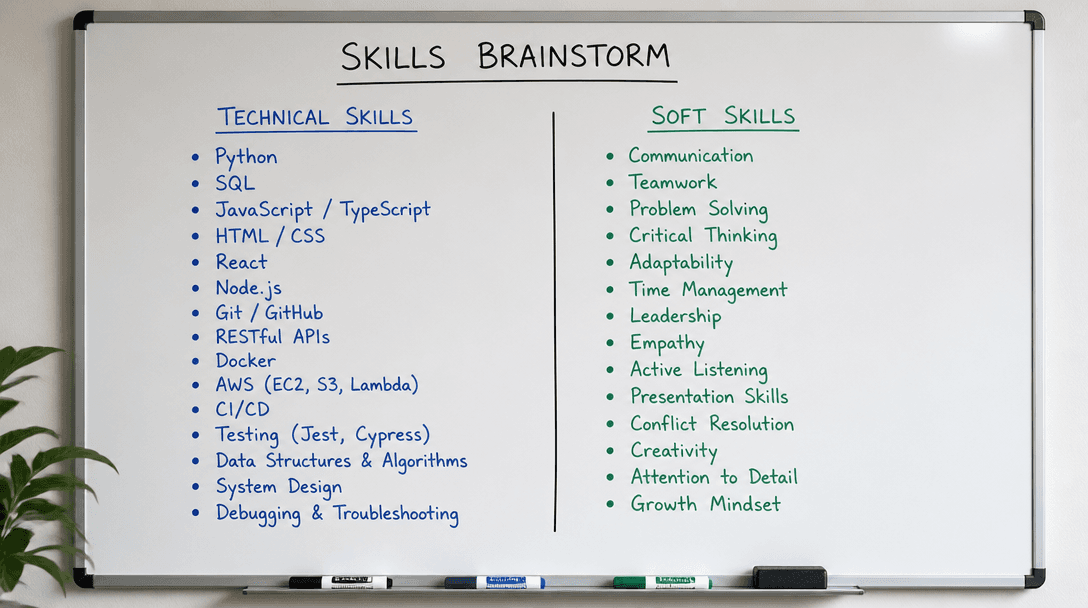
Categorising Your Skills for Maximum Impact
A flat list of 20 skills with no organisation looks like a dump of keywords. Grouping your skills into clear categories makes the section scannable and shows logical thinking - itself a skill that employers appreciate.
For engineering and technical graduates: Use categories like Technical/Core Skills (machine operations, processes, tools), Software Skills (CAD tools, programming languages, simulation software), Analytical Skills (quality analysis, data interpretation, problem-solving methods), and Communication Skills (technical writing, presentation, language proficiency).
For commerce and arts graduates: Use categories like Professional Skills (accounting, data entry, customer service), Software Skills (Tally, MS Office, specific tools), Analytical Skills (financial analysis, report writing), and Interpersonal Skills (teamwork, communication, client handling).
Within each category, list your strongest skills first. HR managers scan from top to bottom and left to right - your most impressive and relevant skills should appear first in each category. If CNC programming is your standout skill, it should be the first item under Technical Skills, not buried after basic fitting operations.
Matching Your Skills to Specific Job Listings
Here's the skill that most freshers don't know they need: the ability to read a job listing and translate its requirements into skills you already have, phrased the way the employer phrases them.
If a job listing says "experience with quality inspection instruments," and you've used vernier calipers, micrometers, and height gauges during your course, you have that skill. But your resume needs to say "Quality Inspection Instruments: Vernier caliper, micrometer, height gauge, dial indicator" - not "measurement" or "instruments." Use the employer's language.
If a listing says "ability to work in cross-functional teams," and you completed a group project in college where each member handled a different aspect (design, fabrication, testing), you have that experience. Frame it as: "Cross-functional teamwork - collaborated on multi-disciplinary projects with team members handling design, fabrication, and testing phases." The employer's exact phrase, backed by your actual experience.
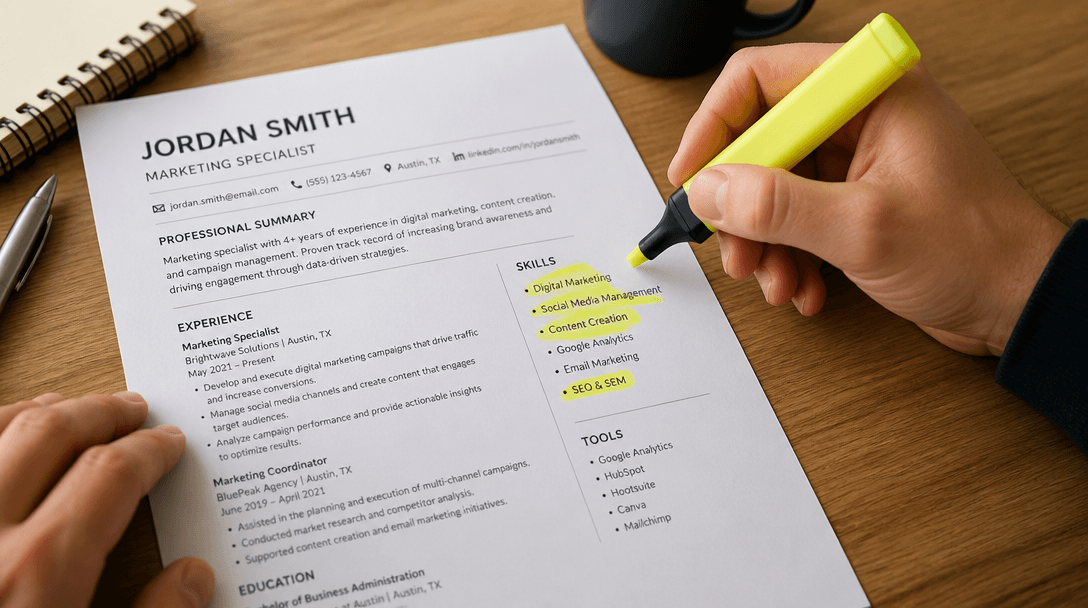
Before submitting your resume for any specific role, compare the skills section of the job listing against your skills section. Highlight the matches. If three out of five required skills are on your resume, you're a reasonable candidate. If one or fewer match, either the role isn't right for you, or your skills section isn't accurately representing your capabilities. Sometimes the mismatch is real (you genuinely don't have the required skills). Sometimes it's a phrasing issue - you have the skill but described it differently than the employer's listing.
Skills to Never List - What Weakens Your Resume
"MS Office" as a standalone skill is meaningless in 2026. Every computer user knows MS Office at some level. Instead, be specific: "Advanced Excel (pivot tables, VLOOKUP, conditional formatting)" or "PowerPoint (presentation design with data visualisation)." Specificity shows competence; generic labels show nothing.
"Hard working" and "team player" - these are personality traits, not skills, and they're unverifiable. Every resume in the stack claims the candidate is hard working. Employers can't assess this from a word on a page. If you want to convey work ethic, demonstrate it through your achievements and project descriptions rather than stating it as a skill.
"Internet browsing" and "email" - these are basic literacy, not professional skills. Listing them suggests your actual skill set is so thin that you need filler. Remove them and use the space for a legitimate skill.
Skills you tried once but can't demonstrate. If you used Python for one semester project and haven't touched it since, listing "Python" as a skill is risky. The interviewer might ask you to write a simple programme, and fumbling reveals the gap between claim and capability. Either practice enough to demonstrate basic competence, or list it as "Basic Python (academic exposure)" to set honest expectations.
Outdated or irrelevant skills. "Knowledge of MS-DOS" or "typing speed 40 WPM" are skills from a different era. Similarly, if you're applying for a mechanical engineering role, listing "Hindi typing" doesn't add value. Keep your skills section relevant to the role and current with technology.
Keep a Master Skills List
Create a master skills list in a notebook or spreadsheet - every skill you've ever learned, used, or been exposed to. This list will be longer than what appears on any single resume. When applying for different roles, you select the most relevant skills from this master list to create a targeted skills section. A quality control role gets your measurement, SQC, and inspection skills prominently featured. A production role gets your machine operations, process knowledge, and shift flexibility highlighted. Same person, same skills, different emphasis - customised for maximum relevance to each opportunity.