
When you're a fresher with no work experience, the idea of negotiating salary feels presumptuous. Who are you to ask for more? You should just be grateful they're offering you a job, right? That mindset costs Tamil Nadu freshers thousands of rupees over the course of their first year - money that compounds into lakhs over a career because every future raise and job change builds on your initial salary.
You absolutely can negotiate, even as a fresher. But you need to know when it's appropriate, what's realistic to ask for, and how to frame the conversation so it strengthens rather than damages your candidacy.
When Freshers Can Negotiate - And When They Can't
Let's be honest: not every hiring situation allows negotiation. Understanding the difference prevents you from either leaving money on the table or annoying an employer with inappropriate demands.
Mass recruitment drives (walk-ins where 50-200 candidates are being hired): Negotiation is usually not possible. These positions have fixed pay scales determined by company policy, not by individual negotiation. When Salcomp or Flextronics hires 100 operators at a time, every hire gets the same salary. Attempting to negotiate in this context wastes everyone's time and might even cost you the offer if the HR team perceives you as difficult. Accept the stated salary, focus on getting hired, and use your performance to earn raises and promotions.
Campus placements: Standard packages are typically non-negotiable. TCS's ₹3.36 LPA, Infosys's ₹3.6 LPA - these are fixed across all campus hires nationwide. The exception is if you've been selected for a premium tier (like TCS Digital or Infosys Power Programmer), where there might be slight variations.
Direct applications to specific roles: This is where negotiation is not just possible but expected. When a company hires individually for a specific position - a maintenance technician, a quality engineer, a production supervisor - the salary often has a range, and the employer expects some discussion. If you've applied directly to a company that called you for an interview, you're in a negotiation-appropriate situation.
Small and medium companies: These are your best negotiation opportunities as a fresher. Smaller employers have more flexibility in their pay structures and are often willing to pay above their initial offer for a candidate who demonstrates strong skills or fills an urgent need. A small auto component company in Ambattur might offer ₹14,000 for a diploma mechanical fresher but be willing to go to ₹16,000-₹17,000 if you demonstrate genuine value during the interview.
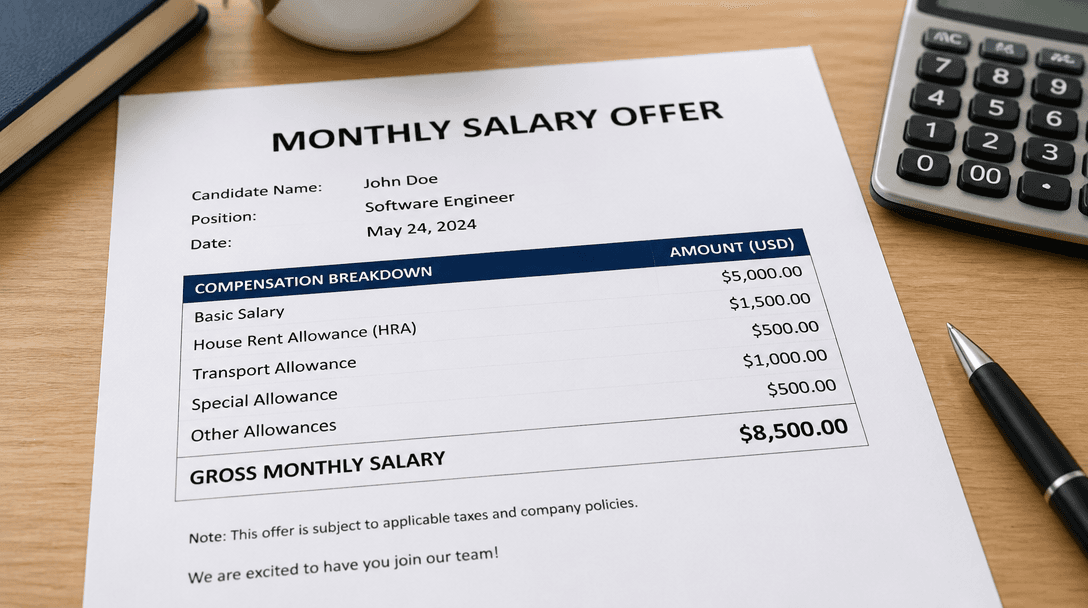
Person reviewing salary offer letter with careful consideration
Know Your Market Value Before You Walk In
You can't negotiate effectively if you don't know what your qualification and skills are worth in the current market. Here's how to research this quickly.
Talk to recent hires. The most accurate salary data comes from people who were recently hired in similar roles. If you know someone who joined a manufacturing company as an ITI fresher six months ago, ask them directly: "What's your take-home after deductions?" People are often surprisingly open about salary when asked privately. Three or four such data points give you a reliable range.
Use Glassdoor and AmbitionBox selectively. These platforms have salary data for Tamil Nadu companies, but filter for freshers specifically and look at the most recent submissions (last 6-12 months). Older data is misleading because entry-level salaries change with inflation and market conditions. Also, be aware that these platforms combine data across cities - a TCS salary in Chennai might differ from TCS in Hyderabad.
Check government minimum wage notifications. Tamil Nadu publishes minimum wages by skill category. Knowing the floor helps you evaluate if an offer is reasonable. For 2026, skilled workers in manufacturing have a minimum daily rate of approximately ₹490-₹550, which translates to a monthly minimum of roughly ₹12,700-₹14,300. Any offer at or barely above minimum wage should be questioned, especially from larger companies that can afford more.
Industry benchmarks by qualification: Use these as rough starting points for Tamil Nadu in 2026. ITI freshers: ₹11,000-₹16,000. Diploma freshers: ₹13,000-₹18,000. B.E freshers in manufacturing: ₹15,000-₹22,000. B.E freshers in IT services: ₹22,000-₹30,000. If an offer falls below the lower end of these ranges for your qualification, you have legitimate grounds to negotiate.
How to Actually Ask for More - Scripts That Work
The moment comes. They say: "We're offering ₹13,000 per month." You believe you're worth more. Here's how to respond without burning the opportunity.
The appreciation-plus-ask approach: "Thank you for the offer - I'm genuinely interested in this role and your company. Based on my research and the CNC certification I hold in addition to my ITI, could we discuss the possibility of starting at ₹15,000? I've seen similar roles with CNC requirements in this area at that range." This approach acknowledges the offer, demonstrates research, and anchors your ask to a specific skill differentiator.
The range response: If they ask you for your salary expectation before making an offer (common in individual interviews), give a range rather than a fixed number: "Based on what I've researched for this role and qualification level, I'd expect something in the ₹15,000-₹18,000 range. But I'm also looking at the overall opportunity - training, growth potential, and work environment matter to me beyond just the starting number." The range gives them flexibility while setting a floor, and mentioning non-salary factors shows maturity.
What to do if they say no: If the company says the offer is fixed and non-negotiable, don't push further. Pushing after a clear "no" damages the relationship. Instead, pivot to non-salary negotiation (covered in the next section) or accept gracefully: "I understand. I'm happy to start at this level and prove my value. Can we discuss a salary review after six months based on my performance?" This gets you a commitment for a future review, which is almost as valuable as a higher starting salary.
Negotiating Beyond Base Salary - Benefits That Add Up
If base salary negotiation hits a wall, there are other elements worth discussing that have real financial value.
Transport or transport allowance. Many manufacturing companies provide buses, but if you're outside their route, ask if they offer a transport allowance. Even ₹1,000-₹1,500 per month for transport effectively increases your take-home without technically increasing your salary. Companies are often more flexible about allowances than base pay because allowances aren't subject to the same PF calculations.
Training and certification support. Ask if the company sponsors skill certifications - CNC programming courses, Six Sigma, AutoCAD, or relevant technical certifications. A ₹10,000 certification that the company pays for is equivalent to a meaningful salary addition and directly increases your market value for future roles.
Accommodation support. Some companies in the Sriperumbudur-Oragadam corridor and Hosur provide company accommodation or subsidised shared housing. If the base salary is non-negotiable, ask if they offer accommodation. Saving ₹3,000-₹4,000 per month on rent is effectively a ₹3,000-₹4,000 salary increase.
Review timeline. If you accept the stated salary, negotiate for an earlier performance review: "Can we agree on a three-month performance review instead of the standard annual review?" An earlier review gives you a faster path to a raise. Many companies agree to this because it costs them nothing upfront and demonstrates your confidence in your own performance.
Get It in Writing
Document everything that's agreed upon. If the interviewer verbally promises a six-month review, a transport allowance, or certification support, politely ask for it to be mentioned in your offer letter or appointment letter. Verbal promises from HR managers get forgotten, especially in companies where the person who interviewed you might not be the person managing you six months later. Getting it in writing protects both parties and prevents misunderstandings that sour what should be the beginning of a positive working relationship.