It's 8 PM and you just saw a WhatsApp message about a walk-in interview tomorrow at 9 AM. The company looks legitimate. The role matches your qualification. But you have exactly 13 hours - minus sleep - to prepare. Most freshers in this situation either panic and overprepare random things, or shrug and decide to "wing it." Both approaches fail. What works is focused preparation on the few things that actually matter in a walk-in interview.
I've watched hundreds of candidates walk into interviews in Chennai. The ones who prepared for even one hour the night before performed noticeably better than those who walked in cold. This checklist gives you exactly what to do with your limited time.
Research the Company - The 30-Minute Version
You don't need to become an expert on the company. You need to know five specific things, and you can find all of them in 30 minutes or less.
What does the company make or do? Go to their website's "About Us" or homepage. Read the first two paragraphs. If it's a manufacturing company like Salcomp, know that they make mobile phone chargers. If it's a company like Pricol, know they make automotive instruments. You need one clear sentence: "They manufacture [product] at their [location] facility." That's enough. When the interviewer asks "What do you know about us?" - and they will ask - this sentence shows you bothered to look them up.
How big are they? Check if they mention employee count, revenue, or number of facilities on their website. A quick Google search with "[company name] employees" or "[company name] revenue" gives you this. Knowing that a company has 3,000 employees across two plants tells you it's an established mid-sized manufacturer - not a startup, not a giant. This helps you set salary expectations and understand the work environment you're walking into.
What's the specific role you're applying for? Re-read the walk-in announcement carefully. Note the job title, required qualification, and any specific skills mentioned. If they've asked for "ITI Fitter with CNC knowledge," your interview preparation should emphasise your CNC exposure, not your general fitter training. Match your preparation to the specific requirement stated in the listing.
What's their product or industry? Spend five minutes understanding the industry context. If it's an auto component company, know which car manufacturers they supply to. If it's an electronics assembler, know what products they assemble. This lets you connect your skills to their needs: "I understand you supply dashboard components to Hyundai, and my diploma project was on quality inspection in auto component manufacturing" - a connection like this, even if brief, sets you apart from candidates who know nothing about the company.
Recent news - if any. A quick Google News search for the company name might reveal a recent expansion, new product launch, or award. Mentioning something recent shows genuine interest. But if you find nothing, don't worry - this is a bonus, not a requirement.

Job seeker reviewing documents and preparing notes late at night before an interview
Prepare Your Documents and Physical Kit
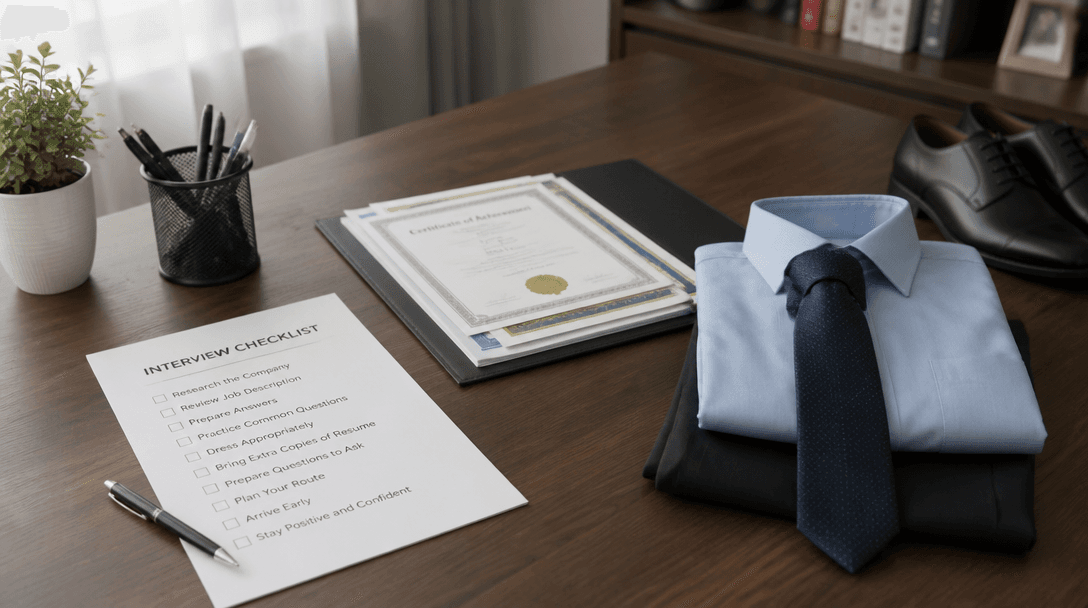
Pack everything tonight so you're not scrambling in the morning. This is where most candidates lose unnecessary marks - showing up with incomplete documents or a disorganised folder.
Resume - print five copies. Yes, five. You might meet multiple interviewers, or the first copy might get filed while you still need one to reference during your conversation. Use clean white A4 paper, not coloured or fancy paper. If you don't have access to a printer at home, locate the nearest Xerox shop that opens early and plan to stop there before the venue. Many shops near bus stands in Chennai open by 7 AM.
Certificate photocopies - one complete set. This includes: 10th marksheet, 12th marksheet, ITI/diploma/degree certificate and marksheets, any additional certifications (CNC, Six Sigma, computer courses), Aadhaar card copy, PAN card copy if you have one, and community certificate if required. Arrange them in chronological order in a transparent file folder. Don't hand over loose sheets.
Passport-size photos - carry at least six. Recent photos, not ones from three years ago. White background, formal attire. If your existing photos show you in a casual t-shirt, they'll work for the application form but won't create the right impression if attached to your resume.
Original certificates - carry them in a separate folder. You'll need to show originals for verification, but never hand them over. If anyone asks you to submit original certificates, that's a red flag. Legitimate companies only need to see originals, not keep them.
The Physical Kit
Blue and black pens - at least two of each. You'll fill out application forms, and they always specify the ink colour. Carry both so you're covered regardless of their requirement. A pencil and eraser are useful too - some aptitude tests require them.
Water bottle and a light snack. Walk-in interviews involve waiting. Sometimes hours of waiting. If you're hungry and dehydrated by the time your turn comes, your energy and focus drop noticeably. A small pack of biscuits and a filled water bottle solve this completely.
Prepare Answers to the Three Questions They Will Ask
Walk-in interviews at manufacturing companies and IT service firms follow a predictable pattern. Three questions appear in almost every single one, and having prepared answers makes the difference between sounding confident and sounding like you're making things up on the spot.
"Tell me about yourself." This is not an invitation to recite your resume. It's a conversation starter. Structure it as: Name → Qualification → What you studied or trained in → Why you're interested in this type of work → One thing that makes you a good fit. Practice saying it out loud tonight - in front of a mirror if possible. Keep it under 90 seconds. The biggest mistake freshers make is rambling for three minutes about their family background and hobbies. The interviewer wants to know if you're qualified, interested, and articulate. That's it.
"Why do you want to work here?" Use your 30-minute research. "I want to work at [company] because you manufacture [product] and I trained in [relevant trade/subject]. I want to apply what I learned in a real production environment, and from what I've read, your company has a strong presence in [industry/location]." This answer demonstrates research, relevance, and genuine interest. Customize it with the actual company name and product - generic answers that could apply to any company sound lazy.
"What are your strengths?" Pick one strength that's directly relevant to the job. If it's a manufacturing operator role: "I'm good at following processes consistently - during my ITI practical training, I was able to maintain quality standards across repetitive tasks without getting distracted." If it's a technical role: "I enjoy troubleshooting - when something breaks down, I like working through the problem systematically until I find the root cause." One genuine, relevant strength is infinitely better than listing five generic ones like "hardworking, honest, team player, quick learner, dedicated."
Your Morning Routine on Interview Day
Set two alarms - one on your phone and one on a clock or a different device. Oversleeping and missing the walk-in after preparing all night is a defeat that's entirely avoidable.
Eat a proper breakfast. Not heavy enough to make you sleepy, but substantial enough that you're not distracted by hunger. Idli, dosa, or bread with egg - something that gives you sustained energy. Avoid skipping breakfast because of nervousness; an empty stomach amplifies anxiety.
Arrive 20-30 minutes early. This isn't generic advice - it's strategic. Being early lets you observe the venue, see how the process is organised, and mentally settle in. If there's a written test first, you get time to calm your nerves before the clock starts. If there's a queue, you get a lower token number, which means you're interviewed when the interviewers are still fresh and patient.
Use the waiting time wisely. Review your resume once. Read through your prepared answers silently. Observe how other candidates interact with the interviewers - you can pick up useful cues about what they're asking and what kind of answers seem to land well.
Silence your phone completely. Not on vibrate - on silent. A phone buzzing during your interview is disruptive and makes you look unprofessional. If your phone is in a locker (common in manufacturing plant interviews), this isn't an issue.
One Last Thing Before You Walk In
Write down one question to ask the interviewer at the end. When they say "Do you have any questions?" - and most interviewers give you this opportunity - asking something thoughtful shows you're thinking beyond just getting hired. Good questions: "What does the training period look like for new joiners?" or "Which department would I be placed in initially?" These questions show you're already thinking about doing the work well, not just about getting the offer letter. Prepare this question tonight along with everything else, and you'll walk into tomorrow's interview better prepared than 80% of the other candidates.