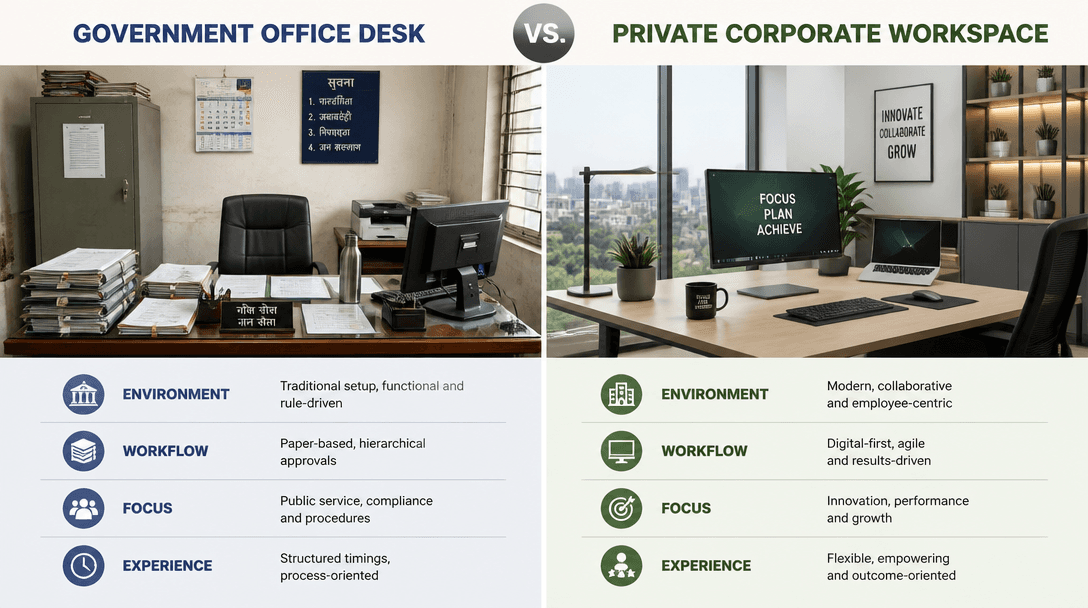
This is the conversation that happens in every Tamil Nadu household when a young person finishes their degree. "Try for government job first." "Take the private job now." "Your cousin got TNPSC Group 2, see how settled he is." "Your friend joined Infosys and is already earning 4 lakhs."
Both sides have valid points. Both sides also have blind spots. What I'm going to do here is lay out the actual comparison - not the idealised version of either path, but the realistic one - so you can make an informed choice based on your specific situation, not someone else's opinion.
The Real Salary Comparison - Numbers Not Feelings
Let me start with the most common misconception: "Government jobs pay less but are more stable." This was true twenty years ago. In 2026, thanks to the 7th Pay Commission and Tamil Nadu's DA revisions, government salaries at entry level are often comparable to or higher than private sector salaries - especially when you factor in benefits.
A TNPSC Group 4 employee (VAO, Junior Assistant) starts at approximately ₹19,500 base pay plus DA, taking home around ₹25,000-₹28,000 per month including allowances. A TNPSC Group 2 officer starts higher - around ₹36,000-₹42,000 take-home. These aren't exceptional salaries, but they come with benefits that have real financial value: government housing or HRA, medical coverage for your entire family, pension after retirement, and fixed annual increments that don't depend on company performance or your manager's mood.
In the private sector, a fresh B.E graduate joining TCS, Infosys, or Cognizant in Chennai starts at ₹22,000-₹30,000 take-home (package of ₹3.3-4.5 LPA). A fresher joining a manufacturing company as a GET starts at ₹15,000-₹20,000 take-home. At first glance, these look similar to government salaries. The difference becomes stark after 5-7 years.
In the private sector, if you're skilled and strategic about job changes, your salary can jump from ₹25,000 to ₹80,000-₹1,00,000+ within 5-7 years. In government, the same period might take you from ₹28,000 to ₹40,000-₹45,000 through increments and promotions. The private sector wins on raw salary growth.
But here's what the private sector comparison doesn't show: the government employee at ₹45,000 per month has zero housing expenses (if in quarters), zero medical expenses, a guaranteed pension, and cannot be fired. The private sector employee at ₹1,00,000 might be spending ₹20,000 on rent, ₹5,000 on health insurance, has no pension, and can be laid off during any "restructuring" or downturn.

Person studying for competitive exams with books and notes at a desk
Job Security: What It Actually Means in Each Sector
Government job security is real. Once you pass probation (usually 2 years for state government, 1-3 years for central), it is extraordinarily difficult for you to be removed from service. Barring criminal misconduct or disciplinary action, your job lasts until retirement at 58-60. This isn't just theoretical - it's structural. The bureaucratic process to terminate a government employee is so complex that it almost never happens for performance reasons.
Private sector job security is conditional. It depends on company performance, your individual performance, industry trends, and sometimes factors completely outside your control. The 2020-2023 period showed this clearly - thousands of IT employees across Chennai were laid off by companies that had been "stable employers" for decades. Manufacturing workers on contract are even more vulnerable - your job exists only as long as the contract exists, which might be 6 months or 11 months at a time.
That said, private sector "insecurity" is sometimes overstated. If you're genuinely good at your work, keep your skills updated, and build a professional network, finding a new job after losing one is usually a matter of weeks or months, not years. The risk is real but manageable. For government employees, the corresponding risk is career stagnation - your job is secure, but your professional growth is tied to a promotion timeline that can take decades.
Career Growth Timelines - Government vs Private
In the private sector, your career grows based on what you can do and what you can negotiate. A software developer at TCS who switches to a product company after 2 years, then joins a startup after 2 more years, can go from ₹3.5 LPA to ₹15-20 LPA in 4-5 years. That's not unusual for the top 20-30% of performers. In manufacturing, a diploma holder who starts as a GET, becomes a shift supervisor in 3 years, and moves to a plant manager track in 7-8 years can reach ₹6-8 LPA - a very comfortable living in a tier-2 city.
In government, career growth follows a fixed promotion timeline. A Group 4 employee takes about 8-10 years to reach the next level. A Group 2 officer might wait 6-8 years for promotion to the next grade. You can't accelerate this by working harder or being more skilled - the timeline is structural, based on seniority and vacancy availability. Some officers spend their entire career waiting for a promotion that depends on someone above them retiring.
The upside of government growth is predictability. You know exactly when your next increment comes (every year, guaranteed). You know roughly when you'll be eligible for promotion. You can plan your life - buying a house, your children's education - with a level of certainty that private sector employees rarely have.
Lifestyle and Work Culture Differences
This is where the comparison gets personal, because the right choice depends heavily on what kind of daily life you want.
Government employees typically work 9:30 to 5:30, Monday to Friday (or Saturday half-day depending on the department). Overtime is rare. Transfers happen, but they're usually within Tamil Nadu for state government roles. You have a fixed routine, predictable hours, and generous leave - earned leave, casual leave, restricted holidays, and compensatory leave that add up to 40-50 days per year.
Private sector work culture varies dramatically by company. IT companies in Chennai might expect 9-10 hour days with occasional weekend work during project deadlines. Manufacturing companies run shifts - 8 hours on the clock, but with overtime demands during production peaks. Startups and smaller companies blur the line between work and personal time entirely. Leave policies are typically 18-24 days per year - significantly less than government.
Social status matters in Tamil Nadu, and I won't pretend it doesn't. A government job - even a Group 4 position - carries social respect in most communities, especially in smaller towns. "Avanga government la irukkanga" (they're in government) carries weight in marriage discussions, loan applications, and community standing. Private sector jobs have gained social acceptance, especially in IT, but manufacturing or BPO jobs don't carry the same social currency in many communities.
How to Make Your Decision Without Regret
Here's a framework that I've found helps people make this decision honestly. Answer these questions for yourself:
Can you afford to wait 1-3 years for a government job? TNPSC preparation is a long game. Most people don't crack it on the first attempt. If your family can support you financially while you prepare, and you're genuinely disciplined enough to study 6-8 hours daily, government preparation is a valid path. But if your family needs you to start earning immediately, taking a private job now and preparing for exams alongside is the pragmatic choice. Many successful government employees prepared while working - it's harder, but it's doable.
Are you comfortable with a salary ceiling? Government salaries have a known ceiling. A state government employee retiring at the highest non-IAS grade might earn ₹80,000-₹1,00,000 per month. In the private sector, there's theoretically no ceiling - but realistically, reaching ₹2,00,000+ per month requires specific skills, strategic career moves, and often some luck.
How do you handle uncertainty? Some people thrive with the security of knowing their career path for the next 30 years. Others find that suffocating and prefer the dynamism (and risk) of the private sector. Neither preference is wrong - but knowing which type you are prevents years of misery in the wrong environment.
A Final Word
The best career move I've seen people make is the hybrid approach: take a private sector job immediately to start earning and gaining experience, then dedicate 2-3 hours daily to government exam preparation. If you crack the exam, you transition to government with both financial stability and real-world work experience. If you don't crack it within 2-3 serious attempts, you've already built a private sector career that's progressing on its own merits. This approach eliminates the worst-case scenario - which is spending years preparing for an exam you might not clear, with nothing else to fall back on. Whatever you choose, make sure it's your decision based on your circumstances, not someone else's idea of what a "good job" looks like.