A candidate from Thanjavur attended a walk-in at a manufacturing company in Oragadam last month. His interview went well, the technical test was fine, and the HR manager was ready to process his application on the spot. Then they asked for his PAN card photocopy. He didn't have one. The company needed PAN for salary account opening and TDS processing. They couldn't complete his joining formalities. He had to come back the following week with the document - and by then, the batch was full.
This isn't an unusual story. I hear versions of it every week. Missing documents don't just cause delays - they can cost you the opportunity entirely if the company is hiring on a first-come-first-served basis. Here's the definitive list of what to carry, arranged so you can prepare your folder once and be ready for any interview at a moment's notice.
Essential Documents - Don't Leave Home Without These
These documents are required at virtually every job interview in India, regardless of the company, sector, or role. Missing any of these is avoidable.
Resume - 5 printed copies. Multiple copies serve multiple purposes: one goes to HR filing, one stays with the interviewer, one might go to the technical panel, and you keep one to reference during the conversation. Print on standard white A4 paper. Use a clear, readable font. Ensure your phone number and email are correct - typos in contact details mean the company literally cannot reach you.
Aadhaar card - 2 photocopies. Aadhaar has become the universal identity document for employment in India. Companies use it for background verification, PF enrollment, ESI registration, and salary bank account opening. Carry clear photocopies where all numbers are legible. Some companies also ask for the original to verify - carry it separately from the copies.
PAN card - 2 photocopies. Required for TDS (tax deduction at source) processing once you're hired. If you don't have a PAN card yet, apply for one immediately through the NSDL website or a nearby facilitation centre. The application costs ₹107 and the card arrives within 2-3 weeks. Having your PAN ready signals that you're prepared for employment - not just the interview.
Passport-size photographs - 10 copies. Recent photographs (taken within the last six months) with white background. Different companies need different numbers - some use one for the application form, others need three for ID card processing. Having ten means you're covered for any requirement. Get them taken at a studio, not a phone selfie printed at a shop.
Bank passbook front page - 2 photocopies. Needed for salary account setup. If you don't have a bank account, open one before attending interviews. A basic savings account at SBI, Indian Bank, or any nationalized bank takes one visit with your Aadhaar and PAN. Many companies have tie-ups with specific banks and will open an account for you, but having an existing account speeds up the joining process.

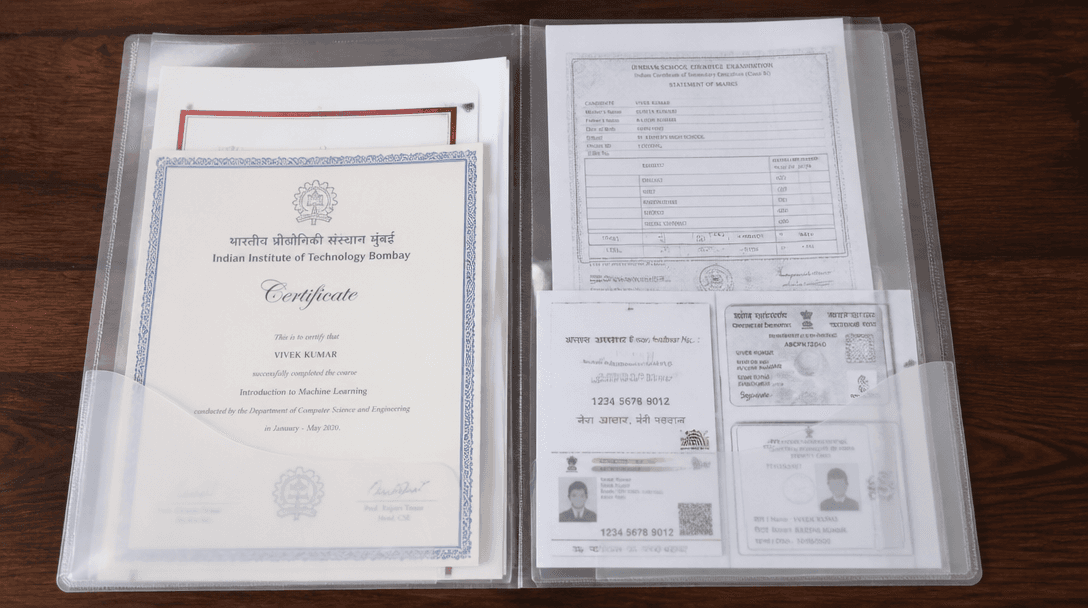
Neatly arranged educational certificates and photocopies in a clear file
Qualification Certificates - What to Bring by Education Level
Carry everything from your highest qualification down to 10th standard. Companies verify your complete educational history, not just the most recent qualification.
10th standard: Marksheet and pass certificate. Some companies ask for your school leaving certificate or transfer certificate. If you have these, include them. If not, don't panic - the marksheet is usually sufficient.
12th standard / HSC: Marksheet and pass certificate. Even if you went directly from 10th to ITI, carry your 10th certificate and ITI certificate.
ITI holders: All semester marksheets, trade certificate, National Trade Certificate (NTC) or National Apprenticeship Certificate (NAC) if completed. If you did apprenticeship training after ITI, carry the apprenticeship completion certificate from the company and the NCVT certificate.
Diploma holders: All semester marksheets, provisional certificate (if degree certificate hasn't arrived), and final diploma certificate. If your college issued a consolidated marksheet, carry that too. Companies sometimes want semester-wise marks and sometimes want the consolidated version.
Degree holders (B.E/B.Tech/B.Com/B.Sc): All semester marksheets, provisional degree certificate, convocation certificate (if received), and any additional certifications (NPTEL courses, online certifications, workshop participation certificates).
Originals vs Copies - The Critical Rule
Carry originals for verification but never submit them. Photocopies are for submission; originals are for show. If any company asks you to deposit your original certificates with them, that is a major red flag. No legitimate employer needs to hold your originals. They verify, note the details, and return them to you.
Extra Documents That Give You an Edge
Beyond the essentials, carrying these documents shows thoroughness and preparation - qualities that interviewers notice.
Community certificate (BC/MBC/SC/ST): Required for government job interviews and some private sector companies that track diversity hiring. Get it from your taluk office if you don't have one - it's free and takes 1-2 weeks.
Experience certificate from previous employment: If you've worked anywhere before - even a short-term contract, internship, or part-time job - carry the experience letter or relieving letter. This validates your resume claims and makes background verification easier.
Driving licence: For roles that might involve company vehicle use, site visits, or any role where mobility is an advantage. Even for desk jobs, a driving licence serves as additional photo ID proof and shows independence.
Portfolio or project documentation: If you're applying for a technical role and have project work to show - code samples, design drawings, quality improvement reports - carry printed copies. Showing tangible output from your training or education period makes your skills claim concrete rather than verbal.
Reference letters: If a professor, previous employer, or mentor has written you a recommendation letter, carry it. References from people known in the industry carry significant weight, especially at smaller companies where personal reputation matters.
How to Organise Your Document Folder
How you present your documents matters as much as having them. An organised folder communicates attention to detail - a quality every employer values.
Use a transparent file folder (the kind with clear plastic pockets). Arrange documents in this exact order from front to back: Resume (front pocket, easily accessible) → Passport photos (in a small envelope clipped to the resume) → Aadhaar copy → PAN copy → Bank passbook copy → 10th certificate → 12th certificate → ITI/Diploma/Degree certificates in chronological order → Additional certifications → Experience letters → Any other documents.
Label each section if the folder allows it. Even without labels, the chronological arrangement means you can quickly pull any document the interviewer asks for without fumbling through the entire stack. Watching a candidate quickly locate the exact certificate requested - without awkward shuffling through loose papers - creates a subtle but positive impression.
Keep originals in a separate folder or section. Don't mix original certificates with photocopies - it creates confusion and increases the risk of accidentally submitting an original.
Always Be Ready
Build your interview document folder once and keep it ready at all times. After each interview, replace any photocopies that were submitted and refill your photo stock. This way, when you hear about a walk-in interview happening tomorrow morning, you grab your folder and go - no scrambling to Xerox shops, no emergency photo studio visits, no panic about missing documents. The candidates who get hired fastest are often not the most talented - they're the ones who are always ready when opportunity appears.