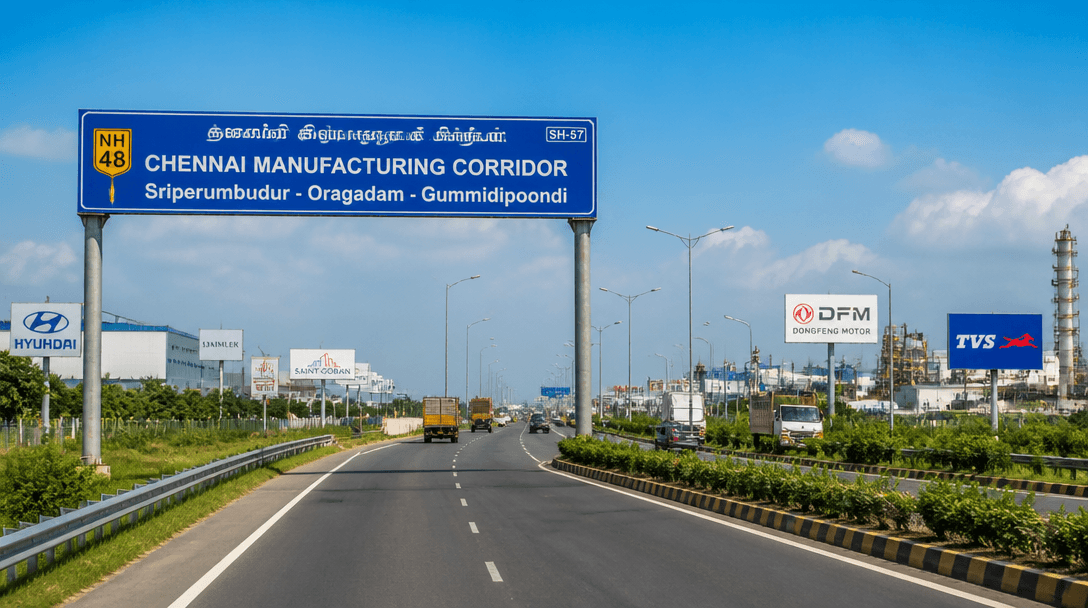
Everyone in Tamil Nadu has heard of the Chennai manufacturing corridor, but most freshers have a vague picture of it - a string of factories somewhere between Chennai and Kanchipuram where jobs supposedly exist. That vagueness is what gets people stuck. They apply randomly, travel to walk-ins without understanding which company does what, and end up frustrated when their skills don't match what the company actually needs.
The corridor is a real, structured industrial ecosystem. Once you understand how it's organised - which companies anchor each zone, how they source workers, and where fresh graduates fit into the chain - your job search becomes dramatically more focused.
Understanding the Chennai Manufacturing Corridor Layout
The Chennai manufacturing corridor runs roughly along the NH48 (now NH4) from the city's western suburbs down through Sriperumbudur, Oragadam, and extending toward Kanchipuram. It's not a single industrial estate - it's a connected chain of Special Economic Zones (SEZs), SIPCOT industrial parks, and private industrial developments spread across about 60 kilometres.
The corridor exists because of three factors that came together: the Chennai port for exports, the NH road network for logistics, and Tamil Nadu's industrial policies that offered land and tax incentives to manufacturers in the early 2000s. Hyundai was one of the first major anchor investments in Sriperumbudur, and once they set up, hundreds of component suppliers followed. That's how industrial corridors grow - one major manufacturer attracts a network of suppliers, and those suppliers attract more, creating a self-reinforcing ecosystem.
For job seekers, the practical implication is this: you don't just apply to Hyundai or Samsung or Renault. You apply to the 30-50 supplier companies clustered around each major manufacturer, because those suppliers are where the volume hiring happens.

Inside a modern automobile assembly plant near Chennai
Sriperumbudur and Oragadam - The Auto and Electronics Hub
Sriperumbudur is the older and more established of the two zones. Hyundai's plant here produces about 700,000 cars annually and directly employs over 10,000 people. Samsung's Chennai factory - one of the largest mobile phone manufacturing plants in India - sits in the Sriperumbudur SEZ. Nokia's former facility (now operated by other electronics manufacturers) and Salcomp (the world's largest mobile charger manufacturer) are also here.
For freshers, Sriperumbudur's main appeal is electronics manufacturing. Companies like Salcomp, Flextronics, and Foxconn hire in large batches - sometimes 100-200 workers at a time - for assembly line positions. These are entry-level roles where you learn to operate specific machines, follow quality protocols, and work in controlled cleanroom environments. The hiring bar is relatively low: 10th or 12th pass for operator roles, ITI or diploma for technician positions. Starting pay for operators is ₹10,000-₹13,000, and for technicians ₹13,000-₹17,000.
Oragadam is newer and heavily focused on automobiles. Renault-Nissan, Daimler (Mercedes trucks and buses), Royal Enfield, and Apollo Tyres all have major plants here. The Oragadam SIPCOT industrial park is massive - over 2,500 acres - and still expanding. For freshers with mechanical or automobile backgrounds, Oragadam offers roles that are closer to traditional manufacturing: machining, welding, assembly, painting, and quality inspection.
The key difference between working in electronics (Sriperumbudur) versus automobiles (Oragadam) is the work environment. Electronics assembly tends to be cleaner, climate-controlled, and involves smaller components. Auto manufacturing involves heavier parts, more physical work, exposure to paint fumes in some departments, and generally higher pay to compensate for the tougher conditions.
How the Tier System Works and Why It Matters for You
Every major manufacturer in the corridor operates within a tier system, and understanding this system is critical for your job search strategy.
The OEM (Original Equipment Manufacturer) is the top - Hyundai, Renault, Royal Enfield. These are the brand-name companies that make the final product. Getting hired directly by an OEM as a fresher is possible but competitive. They typically hire through campus placements from specific engineering colleges or through highly structured walk-in drives where hundreds of candidates show up for limited spots.
Tier 1 suppliers make major components directly for the OEM. For example, a Tier 1 supplier to Hyundai might manufacture the entire dashboard assembly, or the brake system, or the wiring harness. Companies like Mando, Hyundai Mobis, Continental, and Bosch are Tier 1 suppliers in this corridor. These companies have better working conditions and pay than Tier 2 and 3 suppliers, and they hire regularly because their production is tied directly to the OEM's output. When Hyundai increases production, every Tier 1 supplier needs more workers.
Tier 2 suppliers make sub-components that go into Tier 1 products. A Tier 2 company might make the plastic housing for a dashboard component that a Tier 1 company then assembles. These are typically smaller companies with 50-500 employees. They hire more frequently, the interview process is simpler (often a walk-in with same-day results), and while the pay is lower (₹11,000-₹14,000 for freshers), the learning opportunity is often broader because you get exposed to multiple processes.
Tier 3 suppliers make basic parts - fasteners, rubber seals, small stamped metal parts. These are the smallest companies in the ecosystem, often family-run or small-scale industrial units. Pay is lowest here (₹9,000-₹12,000), but these companies are the easiest to get into as a complete fresher. Many experienced manufacturing professionals I know started at Tier 3 companies, gained 6-12 months of experience, and then moved up to Tier 2 or Tier 1 with that experience on their resume.
Where Freshers Actually Enter This Ecosystem
Here's the honest truth about where most freshers start, regardless of their qualification: the majority enter at Tier 2 or Tier 3 level, or through contract staffing agencies that supply workers to OEMs and Tier 1 companies.
Contract staffing is the most common entry point. Companies like TeamLease, Adecco, Manpower, and dozens of local staffing agencies in Sriperumbudur and Oragadam act as intermediaries between you and the manufacturing companies. You work in a Hyundai plant or a Samsung factory, but technically you're employed by the staffing agency. Your salary comes from the agency, and your contract is with them, not the factory.
The advantage of contract positions is easy entry - staffing agencies are always hiring, the interview process is minimal, and you start working quickly. The disadvantage is that contract workers earn 20-30% less than permanent employees doing the same work, and benefits like PF and ESI are sometimes calculated at lower rates. However - and this is important - contract positions are often a pathway to permanent employment. Many companies convert their best contract workers to permanent rolls after 12-18 months. Make this your explicit goal if you take a contract position: work hard enough that the company wants to keep you permanently.
The other entry path is through company-run apprenticeship programmes. Under the Apprentices Act, companies are required to take a certain number of apprentices each year. Apprenticeships in the manufacturing corridor typically last 12 months, pay a stipend of ₹8,000-₹12,000, and give you hands-on experience plus a certificate from the National Council for Vocational Training. Apply for apprenticeships through the apprenticeship portal (apprenticeshipindia.gov.in) or directly through company HR departments.
Practical Steps to Get Started
Register on the apprenticeship portal and apply to every manufacturing company in the corridor. Simultaneously, visit the offices of staffing agencies in Sriperumbudur (there are several along the main road near the bus stand). Drop your resume, attend their briefing sessions, and stay in regular contact. Don't wait for callbacks - follow up every three days. The people who get placed fastest are the ones who show up repeatedly and demonstrate urgency.
An Insider Tip Before You Start
Something practical that nobody tells freshers: join the local workers' WhatsApp groups for the specific industrial area you're targeting. Every SIPCOT zone has informal groups where current workers share information about upcoming recruitment drives, overtime opportunities, and which companies are good to work for. Ask a tea shop near the factory gate - the workers who frequent those shops can point you to the right groups and give you honest feedback about working conditions that no company website will ever tell you.