
Every week, at least five or six people message me saying they lost out on a job - or didn't even apply - because the interview was in English and they didn't feel confident enough. Some of them have excellent technical knowledge. Some of them passed difficult competitive exams. They know their subject cold, but the moment they need to express it in English, their minds go blank and the words don't come.
If this describes you, you need to hear something important: for the vast majority of jobs in Tamil Nadu - manufacturing, IT support, technician roles, government positions - you do not need to speak perfect English. You need functional English. There's an enormous difference between the two, and understanding that difference is the first step to speaking more confidently.
The Level of English You Actually Need for Most Jobs
Manufacturing jobs (operator, technician, supervisor): The interview might start in English, but most manufacturing interviewers in Tamil Nadu switch to Tamil or a mix of Tamil and English within the first few minutes. They're evaluating your technical knowledge and attitude, not your English fluency. If you can introduce yourself in English and answer basic questions (qualifications, work interest, shift willingness) - even with grammatical errors - you're meeting the requirement. On the factory floor, communication happens in Tamil. Period.
IT service companies (TCS, Infosys, Cognizant): These require better English because you'll eventually communicate with clients, write emails, and participate in meetings. But "better" doesn't mean "fluent." It means you can express technical ideas clearly, understand instructions in English, and write basic professional emails. Most freshers from Tamil-medium backgrounds who joined these companies tell me the same thing: their English improved dramatically in the first three months of working because they were immersed in an English-speaking environment every day.
Government jobs: Many government interviews in Tamil Nadu accept answers in Tamil. TNPSC Group 4 interviews are commonly conducted in Tamil. Group 2 and Group 1 interviews may use English, but evaluators are trained to assess content, not language proficiency. A well-structured answer in simple English scores higher than a poorly structured answer in complex English.
The point is this: you need to stop comparing your English to some imaginary standard of perfection and start comparing it to the actual requirement of the job you're applying for. For most roles, simple, clear, error-tolerant English is sufficient.
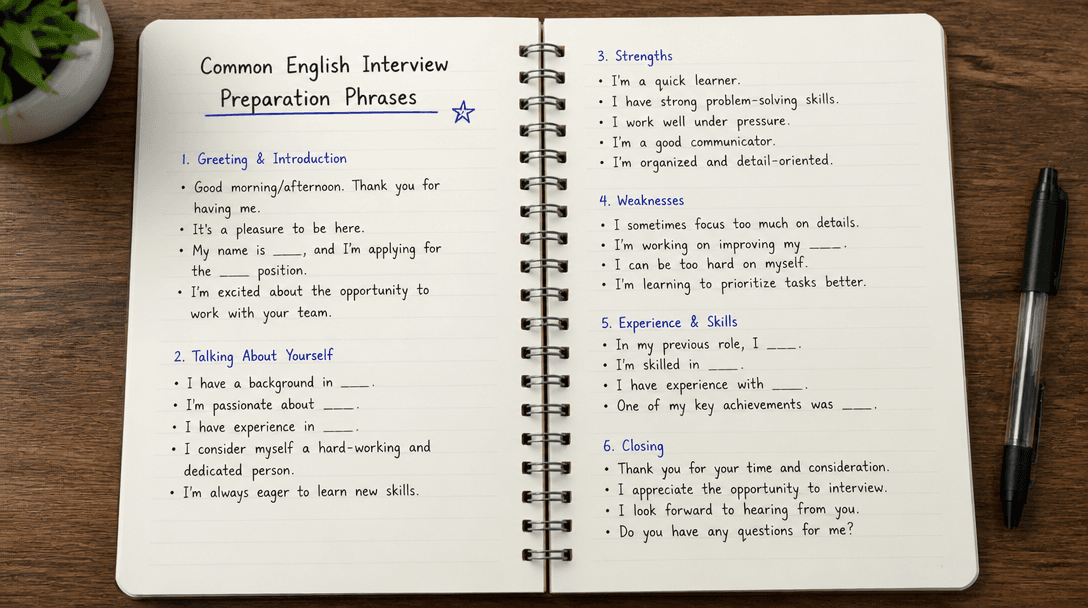
Person practicing English speaking with notes and flashcards
The Thinking-in-Tamil Speaking-in-English Bridge
The biggest obstacle for Tamil speakers isn't vocabulary or grammar - it's the translation delay. You think the answer in Tamil, translate it to English in your head, and then speak. That three-step process creates pauses, hesitations, and sometimes sentences that follow Tamil grammar patterns ("to office I am going" instead of "I am going to the office"). Here's how to shorten that process.
Practice direct association, not translation. When you see a pen on your desk, your brain shouldn't go: Pen → "Pena" → "Pen." It should go: Pen → "Pen." Train this by spending 10 minutes daily looking at objects around you and naming them in English without thinking of the Tamil word first. After a week, your brain starts creating direct English associations for common objects and concepts.
Build sentence templates for interview answers. Instead of translating each answer from scratch, have ready-made English sentence structures that you fill in with specific details. For example: "I completed [qualification] from [institution] in [year], with a focus on [subject/trade]." This template works for any qualification description. You're not translating - you're filling in blanks in a structure you've already practiced.
Record yourself answering common interview questions. Use your phone's voice recorder. Listen back. You'll notice that your spoken English is better than you think - the anxiety makes it feel worse than it actually sounds. Listening to yourself also helps you identify specific patterns to fix: maybe you pause too long before certain words, or you consistently mix up "is" and "are." Fixing two or three specific errors improves your overall fluency more than trying to fix everything at once.
The Tamil Grammar Traps to Watch For
Tamil sentence structure is Subject-Object-Verb (SOV): "Naan velai-kku pogiren" (I work-to go). English is Subject-Verb-Object (SVO): "I go to work." Being aware of this structural difference helps you consciously reorder your sentences in English. Practice converting common Tamil sentences to English word order: Tamil: "Naan diploma complete pannen" → English: "I completed my diploma" (not "I diploma completed"). The more you practice this conversion consciously, the more automatic it becomes.
Phrases That Buy You Thinking Time Without Sounding Lost
When you need a moment to think during an interview, silence feels awkward. But fumbling with "um" and "uh" sounds worse. These professional phrases give you 3-5 seconds of thinking time while maintaining your composure.
"That's a good question - let me think about that for a moment." This is perfectly acceptable in any interview. It shows thoughtfulness, not weakness. Use it when you need time to structure your answer.
"If I understand the question correctly, you're asking about [restate the question]." Restating the question serves two purposes: it confirms you understood correctly, and it gives you extra seconds to formulate your answer. Interviewers see this as a sign of careful communication.
"I want to give you a clear answer, so let me explain it step by step." This phrase sets up a structured response and gives you permission to take your time through each step. It works especially well for technical questions where you might know the answer but need a moment to express it in English.
"In my experience..." or "From what I've learned..." These opening phrases give your mouth something to say while your brain organises the actual content. They're natural conversation starters that don't sound rehearsed.
When you genuinely don't know something: "I'm not familiar with that specific area, but I can tell you about [related thing you do know]." This redirects to your strengths honestly. Honesty delivered in simple, clear English is always better than an elaborate bluff that collapses under a follow-up question.
Daily Practice Methods That Actually Improve Fluency
The single most effective practice method for Tamil speakers learning to speak English confidently is narrating your daily activities in English - silently or aloud. When you're eating breakfast, narrate in your head: "I am eating idli with sambar. The sambar is hot. After breakfast, I will take the bus to the college." This sounds childishly simple, and that's exactly the point. You're training your brain to produce English continuously, not just in isolated phrases during stressful moments.
Watch YouTube videos in English with subtitles turned on. Not Hollywood movies with complex dialogue - start with simple content: cooking channels, tech review channels, or even interview preparation videos. The combination of hearing English while reading the subtitles strengthens both listening comprehension and vocabulary. Do this for 20 minutes daily. After two weeks, you'll notice you understand spoken English significantly better.
Read one English newspaper article daily - The Hindu's Tamil Nadu section is ideal because the topics are relevant to your life. Don't just read silently - read the first paragraph aloud. Reading aloud practices pronunciation, pacing, and sentence rhythm. You don't need to understand every word. Read for flow, not for perfection.
Find an English-speaking practice partner. This could be a classmate, a friend, or even an online language exchange partner. Agree to speak only in English for 15 minutes every day - about anything. The topic doesn't matter; the practice of producing English in real conversation does. Making mistakes in front of a friend is low-stakes practice for the high-stakes interview situation.
Start Practising Today
Before your next interview, write down your answers to the five most common interview questions - in English, in your own words, using simple sentences. Read them aloud five times. By the third reading, the sentences will feel natural. By the fifth reading, you'll be able to say them without looking at the paper. You're not memorizing a script - you're building muscle memory for expressing your thoughts in English. The interview is still a conversation, but having five pre-practiced answers gives you a foundation of confidence that carries through the rest of the discussion, even when the questions go beyond what you prepared.