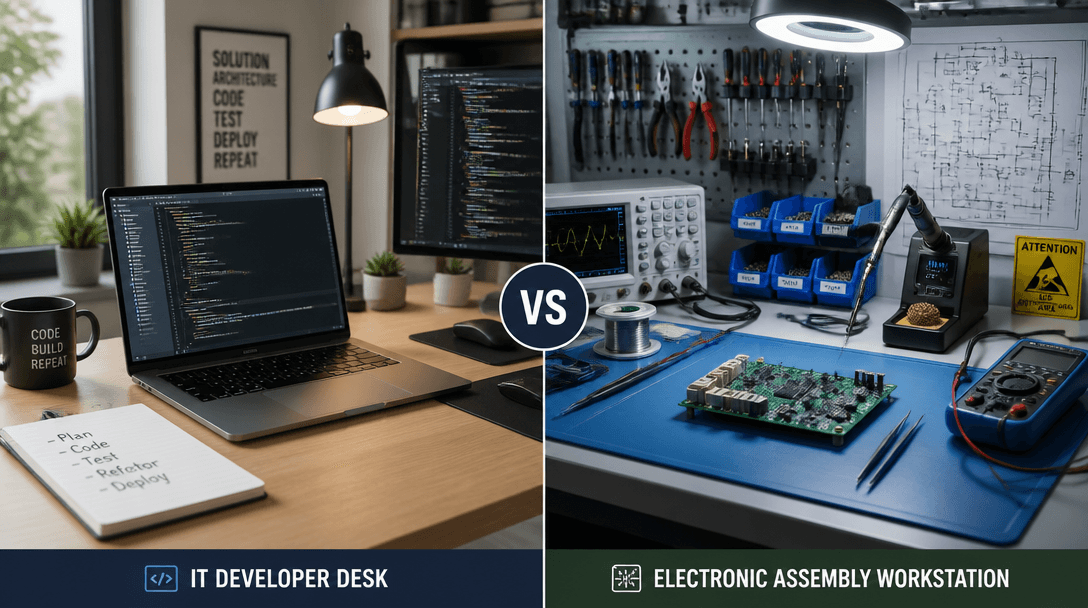
For a huge number of Tamil Nadu freshers, the career question ultimately comes down to two words: manufacturing or IT. One is the state's industrial backbone - the factories of Sriperumbudur, Oragadam, Hosur, and Coimbatore. The other is the glass-and-steel promise of Chennai's IT corridor, OMR, and the software services giants. Families push toward IT for its salaries and status. Reality often pushes freshers toward manufacturing, which hires more broadly. Both are legitimate, substantial careers - but they suit very different people, and choosing badly can mean years in a path that fights your strengths.
This is an honest comparison, not a sales pitch for either side. By the end you should be able to see clearly which path fits your qualifications, your temperament, and your circumstances.
This Is Not a Question of Status
Let's clear away the biggest distortion first: the idea that IT is inherently "better" than manufacturing. That belief has pushed countless capable people into IT roles they were unsuited for, and kept them away from manufacturing careers where they'd have thrived and earned well. Status is a bad basis for a decade-long decision. A skilled CNC programmer or production manager can out-earn and out-stabilise a struggling mid-tier IT support employee. Judge these paths on fit and outcomes, not on which one sounds more impressive at a family gathering.

A career counsellor advising a fresh graduate on choosing between career paths
Entry Barriers: Who Can Actually Get In
Manufacturing has a wide door. A 10th/12th-pass candidate, an ITI holder, a diploma holder, and a degree holder all have realistic entry points, from operator to technician to trainee engineer. If you need to start earning soon and don't have a strong academic profile, manufacturing will hire you and train you.
IT, specifically the software services roles everyone imagines, has a narrower and more academic door. The large service companies typically hire engineering graduates (and increasingly computer-science-adjacent degrees) with a minimum marks threshold, and select through aptitude tests, coding rounds, and communication assessments. English fluency and comfort with abstract problem-solving matter a great deal. There are broader IT-adjacent roles (BPO, tech support, data entry, testing) with lower barriers, but the high-growth software path is genuinely selective. If you're not a graduate, or your degree and English aren't strong, the premium IT path is largely closed - and pretending otherwise wastes years.
Pay and Growth Over Ten Years
Entry pay is closer than people think. A fresher operator or technician in manufacturing might start around ₹12,000-₹18,000 take-home; a fresh graduate at a major IT services firm around ₹22,000-₹30,000. IT usually starts higher, but not by the multiples families imagine.
The divergence comes with time and, crucially, with skill. In IT, a strong performer who keeps learning in-demand technologies and changes jobs strategically can reach ₹80,000-₹1,50,000+ within five to seven years - the upside is genuinely high, but it's concentrated among those who keep upgrading; those who stagnate can find themselves stuck or vulnerable. In manufacturing, the climb from operator to supervisor to executive to manager can take you to ₹60,000-₹1,20,000 over eight to twelve years, more steadily and predictably, especially if you upgrade your qualification along the way. IT has the higher ceiling and faster potential; manufacturing offers a more predictable, steadier ascent.
Job Security and Lifestyle
Neither is perfectly secure. IT is exposed to global demand, client budgets, automation, and periodic layoff cycles that have hit Chennai hard in recent years; skills can also age quickly, so standing still is itself a risk. Manufacturing is exposed to production cycles and, for contract workers especially, to fluctuating demand - though core skilled trades tend to stay employable, and skills age more slowly.
Lifestyle differs sharply. IT generally means desk work, screen time, project-deadline crunches, and often better-appointed offices and hybrid options. Manufacturing means being on your feet, shift work (including nights), physical environments, and a hard boundary between work and home once your shift ends. Some people are energised by hands-on, tangible work and would be miserable at a desk; others are the reverse. This is not a small factor - it shapes your daily happiness for years.
Who Should Choose Which - An Honest Framework
Lean manufacturing if: you have an ITI, diploma, or non-engineering profile; you need to start earning soon; you're practical and hands-on and dislike sitting still; you value steadier, more predictable progression; or you want to build near home in an industrial district rather than relocate to a metro IT hub.
Lean IT if: you're an engineering (or CS-adjacent) graduate with reasonable marks and genuine English fluency; you enjoy abstract problem-solving and continuous self-teaching; you're comfortable with higher volatility in exchange for a higher ceiling; and you're willing to keep learning new technologies indefinitely, because the field never stops moving.
Be honest with yourself on English and academic aptitude in particular - not because they define your worth, but because forcing the IT path without them is one of the most common and costly mismatches Tamil Nadu freshers make.
The Hybrid Truth Nobody Mentions
The two worlds are also converging, and that opens a third option. Modern manufacturing increasingly runs on automation, PLCs, data, and software-controlled machines - so a manufacturing background combined with automation, CNC-programming, or industrial-IT skills sits in a genuinely valuable and less-crowded space. If you're drawn to the tangible world of the factory but want technology exposure and stronger long-term prospects, aim for that intersection deliberately: start in manufacturing, then build automation and digital skills on top. You don't always have to pick one side of the wall. Sometimes the smartest career is built right on top of it.